

Ultrasonic Motor Market Size to Hit USD 69.39 Billion by 2033, Expanding at 21.3% CAGR as Demand for Precision Motion and Miniaturized Actuation Accelerates – Verified Market Research
The global Ultrasonic Motor Market is being reshaped by rising requirements for high-precision, low-backlash actuation across cameras, medical equipment, semiconductor production devices, and robotics. Industry demand is increasingly concentrated in compact, wear-resistant motion systems that can replace traditional mechanical drive components in high-cycle applications. According to Verified Market Research®, Asia Pacific leads global consumption on the back of dense consumer electronics manufacturing and industrial automation scale, while Travelling Wave Type technology retains category leadership due to its efficiency in precision positioning tasks. The market outlook through 2033 points to sustained, application-driven expansion as ultrasonic actuation transitions from a niche precision technology into a broadly deployed motion-control platform.
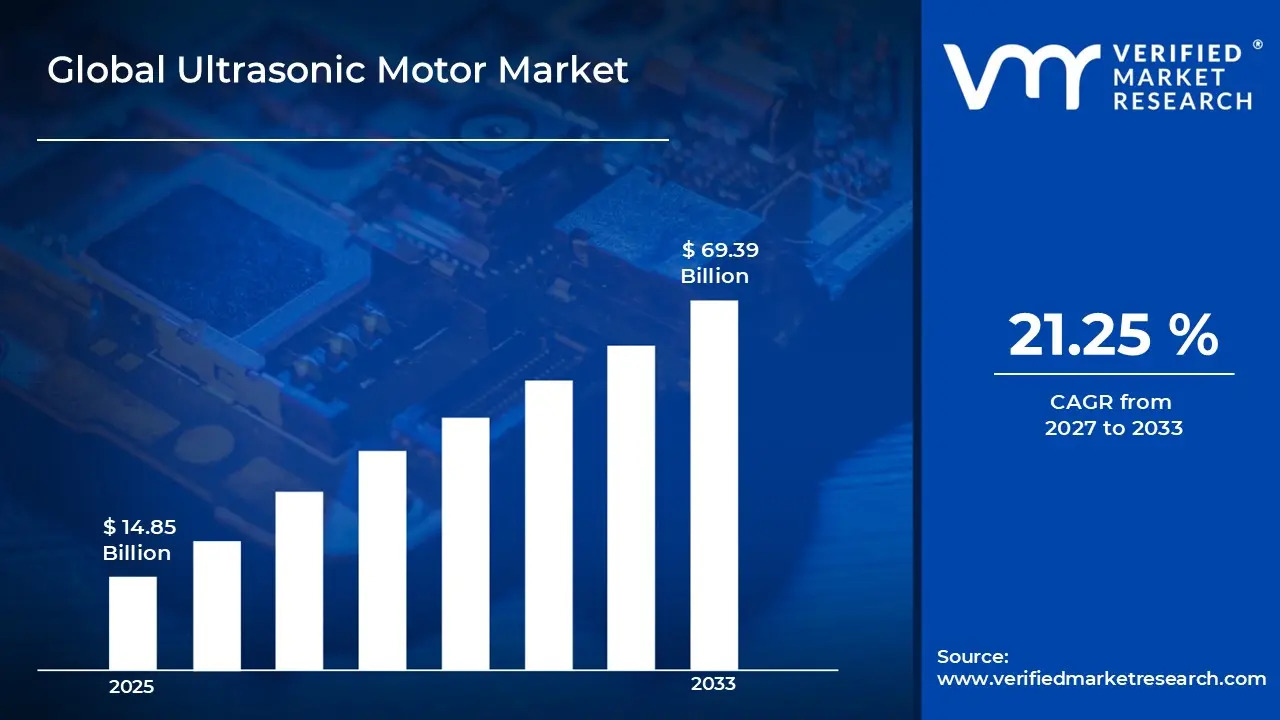
Lewes, Delaware, Aug. 19, 2026 (GLOBE NEWSWIRE) -- Verified Market Research® has published new findings on the Global Ultrasonic Motor Market Size, valuing the industry at USD 14.85 Billion in 2025 and projecting it to reach USD 69.39 Billion by 2033, reflecting a compound annual growth rate (CAGR) of 21.3% across the 2025 - 2033 forecast period. The Ultrasonic Motor Market Size trajectory reflects accelerating adoption of piezoelectric-driven actuation across precision-critical industries, including imaging, healthcare, semiconductor manufacturing, and robotics. The report, titled “Ultrasonic Motor Market Size By Product Type (Travelling Wave Type, Standing Wave Type, Vibrating Reed Type), By Application (Camera, Roll Screen, Medical Equipment, Semiconductor Production Device, Robot and A Manipulator), By Geographic Scope And Forecast,” provides cross-regional, multi-application, and product-type coverage supported by competitive mapping across more than 240 pages.
 Download a free sample to access exclusive Insights, Data Charts, And Forecasts From Ultrasonic Motor Market Sample Report
The Ultrasonic Motor Market Growth outlook is underpinned by a well-defined cause-and-effect chain: precision motion requirements in optics, automation, and medical technology are increasing the operational duty cycle of actuators, which in turn is intensifying demand for motion systems engineered for lower wear and more consistent long-term performance.
Market Overview
The Ultrasonic Motor Market covers the commercialization of ultrasonic actuation systems in which motion is generated through piezoelectric-driven vibration rather than electromagnetic torque or conventional geared transmission. Participation in this market is defined by the supply of ultrasonic motor products and the closely integrated actuation assemblies used to produce controlled rotational or linear movement in precision equipment. Market coverage spans ultrasonic motors supplied as discrete components as well as motor-in-module offerings in which the motor serves as the controlling actuator for position, speed, or holding performance.
What distinguishes the Ultrasonic Motor Industry from adjacent motion-control categories is the functional role the actuator plays within the broader mechatronics stack. Ultrasonic motors function as precision motion engines that enable compact drive solutions, high-resolution positioning, and reliable operation in applications where audible noise, backlash, or limited space present material design constraints. Market valuation boundaries therefore focus specifically on the ultrasonic motor technology value embedded within the end product, including the motor hardware and its essential performance-defining subsystems.
To preserve analytical clarity, the report excludes several adjacent categories that are frequently confused with ultrasonic actuation. The scope excludes piezoelectric actuators that do not rely on ultrasonic motor principles for sustained rotary or linear drive, as these are typically classified as direct piezoelectric displacement actuators or resonant vibration elements. It also excludes conventional electromagnetic motors that depend on windings, permanent magnets, or variable reluctance without an ultrasonic piezo-driven mode, along with geared, stepper, or servo-based motion systems in which any ultrasonic components are incidental rather than the primary motion driver. These exclusions ensure that the Ultrasonic Motor Market Forecast reflects a supply chain and qualification logic distinct from neighboring drive-technology markets.
Download a free sample to access exclusive Insights, Data Charts, And Forecasts From Ultrasonic Motor Market Sample Report
Key Growth Drivers
The Global Ultrasonic Motor Market is being propelled by several interlinked structural drivers that are increasing both replacement frequency and net actuator content per system.
Miniaturization and Precision Motion Requirements
Ultrasonic motors convert electrical input into precise micro-motions without traditional rotary gearing, which helps original equipment manufacturers (OEMs) control positioning accuracy and repeatability within tight mechanical envelopes. As device makers continue to shrink optics, sensors, and mechatronic assemblies, actuator footprint and vibration tolerance are becoming gating design factors. This driver is intensifying Ultrasonic Motor Market demand wherever compact form factors require stable focus, reliable tracking, and smoother motion profiles directly translating into design wins across camera modules, portable imaging systems, and precision automation platforms.
Substitution From Mechanical Drive Systems in High-Cycle Equipment
High-cycle actuation accelerates wear in conventional mechanical drive systems, increasing maintenance needs, performance drift, and warranty exposure. Ultrasonic motors reduce dependence on friction-heavy transmission paths, helping equipment maintain functional performance across repeated operating cycles. As manufacturers increasingly prioritize uptime, throughput stability, and lower lifecycle cost, this substitution mechanism is expanding the Ultrasonic Motor Market as OEMs re-architect motion subsystems to support longer service intervals and more consistent performance.
Faster Product Refresh Cycles and Integration Flexibility
Accelerating platform refresh cycles in industrial automation and consumer imaging are increasing demand for actuator programmability and integration flexibility. Ultrasonic motors support electronic control integration and tunable motion profiles that adapt to different mechanical loads and duty cycles, allowing system integrators to update product designs without redesigning entire drive trains. This flexibility is supporting faster procurement cycles for new modules, upgrades, and derivative models across both industrial and imaging applications, further reinforcing overall Ultrasonic Motor Market Growth.
Ecosystem-Level Reinforcement
At the ecosystem level, growth is reinforced by supply chain evolution and deeper integration between piezoelectric materials expertise and control electronics capability. Manufacturers are expanding capacity and improving yield learning for piezo-based components, which reduces cost volatility and shortens lead times for OEM qualification. Parallel progress toward clearer component interfaces and more consistent performance characterization is helping standardize integration across product teams and regions, making it operationally feasible to redesign motion subsystems at scale rather than relying on custom, low-volume deployments.
Segment-Linked Drivers
- Camera: Growth is driven primarily by the miniaturization-and-precision mechanism, where compact optics and sensors require stable, low-backlash positioning under tight tolerances and repeatable focus or tracking performance.
- Roll Screen: Substitution from wear-prone mechanical drive paths to more durable actuation is the dominant driver, as repeated travel cycles make lifecycle reliability a primary purchase criterion.
- Medical Equipment: The programmability-and-integration mechanism dominates, as motion subsystems must match varied procedures and patient-safety constraints through tunable, controlled motion behavior.
- Semiconductor Production Device: Demand for wear-resistant, uptime-focused actuation dominates, as actuator drift and maintenance events directly affect yield economics in continuous production runs.
- Robot and A Manipulator: Growth benefits from miniaturized motion systems and integration flexibility, as rapid platform iteration requires adaptable actuator control across payloads and mechanical configurations.
Emerging Opportunities
The Ultrasonic Motor Market Opportunity landscape is concentrated in application-specific engineering that favors compact motion control, precision positioning, and low-noise performance, with defensible differentiation emerging around specific design architectures rather than uniform, undifferentiated scale.
- High-precision motion modules for imaging autofocus and optical alignment, relevant to actuator manufacturers and system integrators supplying camera and imaging OEMs, where value is captured through application-tuned variants, life-cycle reliability validation, and production process control that reduces unit-to-unit performance drift.
- Thin, energy-efficient actuators for roll screens and compact electromechanical modules, where opportunity is driven by form-factor constraints on motor size and torque density, and captured through broader configuration portfolios, improved torque linearity, and optimized drivability that lowers thermal risk.
- Medical equipment positioning and micro-actuation built around reliability-first design, where low vibration behavior, silent operation, and precise micro-positioning are valued, and value is captured through tightly specified drive profiles, mechanical integration support, and robust qualification data.
- Process-tool compliance for semiconductor production device stages, where motion control must remain stable under thermal variation and repeatability-critical steps, captured through drive-and-feedback optimization and reduced assembly-tolerance variability.
- Automation-friendly ultrasonic drive for robot and manipulator precision control, where integrators favor smooth, low-noise motion systems, captured through payload-matched variants, refined drive electronics, and integration documentation that accelerates commissioning.
Qualification and supply scaling for precision camera autofocus mechanisms also expands usable capacity and reduces delivery risk across OEM programs, rewarding suppliers that can qualify by platform rather than by individual project and sustain consistent output under forecast-driven purchasing. Similarly, semiconductor process tool automation is creating opportunity for ultrasonic motors engineered with contamination control and maintainability tailored to factory uptime requirements, particularly for vendors that can document installation, cleaning, and replacement procedures aligned to facility servicing schedules.
Download a free sample to access exclusive Insights, Data Charts, And Forecasts From Ultrasonic Motor Market Sample Report
Market Challenges and Restraints
Despite a strong growth trajectory, the Ultrasonic Motor Market faces structural restraints that moderate near-term adoption velocity.
Qualification and Reliability Assurance Costs
Adoption is constrained where manufacturers must validate long-term wear behavior, acoustic-driven vibration performance, and failure modes under temperature cycling and dust exposure. These qualification cycles increase engineering time and testing spend ahead of production ramp particularly for camera autofocus assemblies and precision optics modules delaying design wins and compressing margins during early scale-up.
High Unit Costs and Drive Electronics Complexity
Achieving stable torque, low noise, and accurate positioning requires specialized drivers, control strategies, and system-level integration, all of which increase bill-of-materials cost and design overhead. Where these requirements outweigh the performance benefit relative to alternative technologies, higher total system cost discourages broad switching, limiting volume orders and tightening profitability.
Supply and Manufacturing Consistency Constraints
Operational variability in piezoelectric stack production, bonding processes, and actuator assembly tolerances can restrain scaling. Batch-to-batch performance drift affecting torque uniformity or acoustic output raises incoming inspection rates and reject costs, reducing supplier reliability and complicating long-term sourcing commitments particularly in applications such as semiconductor process positioning and robotic manipulators that require tight repeatability.
At the ecosystem level, these restraints are amplified by supply chain bottlenecks, only partial standardization across driver and actuator interfaces, and constrained production capacity for tightly toleranced components. When suppliers cannot consistently deliver actuator subassemblies alongside compatible drive electronics, OEM integration schedules slip and qualification costs rise, making procurement teams more cautious about multi-source commitments and slowing expansion into new geographies and application programs.
Technology and Innovation Trends
Technology is a primary determinant of capability, efficiency, and adoption within the Ultrasonic Motor Industry, as performance constraints in actuation directly shape where ultrasonic motors can be deployed. The market's technology landscape is defined by the interplay between piezoelectric actuation, resonant mechanical behavior, and closed-loop or sensor-assisted control, in which electrical excitation is converted into controlled mechanical motion through piezoelectric deformation that excites a resonant structure.
- Drive signal robustness and control stability under variable loads: Innovation is focused on sustaining stable motion behavior despite load changes, thermal gradients, and assembly-to-assembly variation, improving positioning and torque repeatability in precision equipment such as camera mechanisms and roll screen modules.
- Mechanical structure and friction interface engineering: Refinements to resonator structures and motion interfaces target degradation mechanisms such as surface wear, micro-slip, and performance drift, extending practical duty cycles and supporting scaled deployment in medical equipment, semiconductor production devices, and robotics.
- Integration pathways for compact modules and application-specific packaging: Development increasingly treats ultrasonic motors as application-integrated motion subsystems rather than drop-in actuators, engineering housing geometry, alignment, cable routing, and thermal paths alongside the motor itself to improve manufacturability in space-constrained products.
Collectively, these innovation areas are enabling the market to evolve from component-level adoption toward broader, more scalable implementation with control stability reducing variability in demanding motion tasks, structural and interface engineering limiting long-term performance drift, and application-specific packaging enabling scale in thermally and spatially constrained products.
In parallel, the market's technology trend line points toward modularization rather than configuring each ultrasonic motor for a narrow application from scratch, manufacturers are standardizing core motor architectures and packaging options, then adapting performance tuning and control behavior at the module level. This is enabling more repeatable interface definitions for drive electronics, mounting geometries, and feedback integration, changing qualification schedules and creating a more predictable basis for selecting product type across camera, roll screen, medical, and semiconductor handling applications.
Industry Use Cases and End Users
Ultrasonic Motor Market demand is shaped less by the existence of motors themselves and more by how end systems translate controlled motion into measurable outcomes such as positioning accuracy, response time, and controllability.
Camera
Camera applications concentrate on high miniaturization density and friction-sensitive actuation paths, where low-backlash behavior and controllable torque at small strokes influence optical performance. Precision focusing and lens actuation is a leading use case, in which ultrasonic motors are integrated into compact optical assemblies to translate electronic commands into fine positional changes, supporting consistent focus behavior across repeated imaging sequences.
Roll Screen
Roll screen applications emphasize incremental or continuous movement under packaging and mounting constraints, where motor drive must maintain predictable movement despite mechanical load changes. Stepwise positioning for roll screen mechanisms in controlled environments requires reliable engagement rather than only reaching an end position, rewarding motor solutions that sustain stable motion behavior across extended operating hours.
Medical Equipment
Medical equipment applications are defined by stringent motion repeatability within tightly constrained assemblies and the need for stable performance across operating conditions that affect calibration and patient-facing reliability. Repeatable micro-motion control in medical device mechanisms supports therapeutic or diagnostic functionality, with demand shaped by the requirement for predictable actuation characteristics that support regulatory-grade performance documentation.
Semiconductor Production Device
Semiconductor production device applications focus on precision, process repeatability, and motion smoothness that reduce the risk of process variability, with utilization shaped by uptime targets, cleanliness requirements, and component serviceability.
Robot and A Manipulator
Robot and a manipulator applications require coordinated actuation for dynamic, multi-axis tasks, where the motor's controllability directly influences trajectory quality, cycle time, and the robustness of automation workflows.
Download a free sample to access exclusive Insights, Data Charts, And Forecasts From Ultrasonic Motor Market Sample Report
Regional Outlook
The Ultrasonic Motor Market shows distinct regional demand maturity patterns shaped by end-user concentration, industrial modernization cycles, and the pace of robotics and precision imaging adoption.
North America
North America is characterized by a mature base of high-value deployments paired with selective, innovation-driven expansion in automation-heavy industries. Demand is pulled by precision optics and imaging supply chains, semiconductor-related equipment modernization, and robotics programs requiring compact actuation, fine motion control, and low backlash behavior. Compliance and qualification requirements in regulated industries tend to lengthen validation phases but improve long-term adoption once integration requirements are met. Key regional factors include end-user concentration in precision automation, rigorous qualification cycles in regulated and safety-critical uses, adoption driven by system integration capability, selective capital investment planning, mature supply chains for precision components, and enterprise-driven purchasing patterns tied to defined specifications and service expectations.
Europe
Europe shapes the market through a regulation-led, quality-first operating model, with EU-wide harmonization requirements intensifying product qualification discipline for applications such as camera autofocus modules, precision medical actuators, and semiconductor production device positioning systems. Key regional factors include EU harmonization and certification readiness, sustainability compliance and materials scrutiny, quality expectations within precision OEM ecosystems, cross-border supply integration with standardized interfaces, regulated innovation pathways for industrial deployment, and public policy and institutional procurement constraints that favor robust quality systems and predictable delivery over purely cost-led selection.
Asia Pacific
Asia Pacific is shaped by expansion-led demand tied to high-throughput manufacturing and fast equipment refresh cycles, and the region holds an estimated 45% share of the global market, driven by consumer electronics manufacturing scale and industrial automation demand. Market behavior varies between mature industrial ecosystems such as Japan and Australia and higher-velocity adoption environments across India and parts of Southeast Asia. Key regional factors include industrial automation scaling with uneven baselines across economies, a large end-market population driving equipment volume, cost competitiveness within regional manufacturing ecosystems, urban infrastructure expansion enabling robotics adoption, regulatory and procurement heterogeneity across countries, and government-led industrial initiatives influencing capital spend toward automation and semiconductor capacity.
Latin America
Latin America represents an emerging segment within the Ultrasonic Motor Market, with adoption expanding gradually as device makers localize components and industrial automation spending becomes more selective. Demand is concentrated in Brazil, Mexico, and Argentina, where camera supply chains, medical device manufacturing, and robotics pilots create periodic pull for precision actuation. Key regional factors include currency volatility affecting procurement timing, an uneven industrial base across countries, dependence on cross-border supply chains, infrastructure and logistics limitations, regulatory and policy variability, and a gradual increase in foreign investment and integration.
Middle East & Africa
The Middle East & Africa region is characterized as a selectively developing regional market rather than a uniformly expanding one, with Gulf economies, South Africa, and a small set of industrial and logistics hubs shaping demand intensity. Key regional factors include policy-driven modernization in Gulf economies, infrastructure and readiness gaps across African industrial markets, high reliance on imported components and external supply chains, demand concentration in urban and institutional procurement centers, regulatory and standards variability across countries, and gradual market formation through public-sector and strategic industrial projects.
Download a free sample to access exclusive Insights, Data Charts, And Forecasts From Ultrasonic Motor Market Sample Report
Competitive Landscape
The Ultrasonic Motor Market is best characterized as technologically concentrated but commercially fragmented, with competition pivoting around performance and reliability in demanding motion-control tasks rather than pure unit cost. Key differentiators include torque-per-volume, positional repeatability, acoustic and electromagnetic compatibility, thermal stability, and lifecycle qualification. Nidec Corporation leads the competitive set due to its broad actuation portfolio and scale in industrial-grade ultrasonic motor production.
Canon Inc. operates as a systems integrator whose ultrasonic motor adoption is tied to imaging performance targets and mechanical module design constraints, with differentiation centered on engineering feedback loops between actuator behavior and optical/mechanical requirements such as focus and lens positioning stability. Its procurement behavior tends to shift competitive pressure toward vendors offering stable production planning, documented reliability data, and interface compatibility for high-volume manufacturing.
Ricoh Company Ltd. blends device-level integration with motion subsystem optimization for imaging and related precision mechanisms, emphasizing manufacturability and integration with camera and imaging hardware architectures. Its influence reinforces a pathway in which ultrasonic motor suppliers must align to both electrical and mechanical specifications as well as the production quality systems required by imaging OEMs.
Micromechatronics, Inc. functions primarily as a specialist supplier and development-oriented partner, with differentiation anchored in mechatronic engineering capability and actuator design know-how. Its leverage comes from translating end-user motion-control requirements into actuator physics choices, such as waveform strategy and structural design alignment for travelling wave, standing wave, or vibrating reed implementations.
Nikon Corporation competes through precision engineering and platform integration in optical and imaging systems, with stringent qualification expectations for motion smoothness, repeatability, and endurance under varied environmental conditions. This drives ultrasonic motor vendors toward tighter process control and more robust quality documentation.
PI (Physik Instrumente) GmbH & Co. KG operates as an equipment and motion-system technology provider, influencing competition through integration requirements for precision instrumentation and automated measurement environments where control loops, mechanical stiffness, and vibration management are critical. Its procurement behavior contributes to a broader shift toward qualification-grade components and tighter integration specifications.
Beyond these profiled companies, competitive pressure is distributed across a wider set of participants, including:
- Sony Corporation
- SHINSEI Corporation
- SIGMAKOKI Co. Ltd.
- Seiko Instruments
- OLYMPUS Corporation
- Technohands Co., Ltd.
- APC International Ltd.
- Fukoku Co., Ltd.
- Tamron Co. Ltd.
- Dynamic Structures and Materials, LLC
Collectively, these participants cover different layers of the value chain, including actuator specialization, integration into imaging or medical device mechanisms, and supply continuity for industrial customers. Because qualification barriers in medical equipment and semiconductor production device environments incentivize suppliers with documented performance, the competitive evolution is expected to favor deeper specialization over immediate consolidation through 2033.
Download a free sample to access exclusive Insights, Data Charts, And Forecasts From Ultrasonic Motor Market Sample Report
Market Segmentation
By Product Type
- Travelling Wave Type - the dominant segment, favored for superior efficiency across precision positioning applications and continuous motion capability.
- Standing Wave Type - aligned with compact form factor requirements and controllable incremental actuation.
- Vibrating Reed Type - suited to compact precision tasks requiring localized movement and mechanical simplicity.
By Application
- Camera
- Roll Screen
- Medical Equipment
- Semiconductor Production Device
- Robot and A Manipulator
By Geography
- North America
- Europe
- Asia Pacific
- Latin America
- Middle East & Africa
Strategic Outlook Through 2033
The Ultrasonic Motor Market Forecast points to uneven but sustained expansion through 2033, with growth concentration expected in segments connected to precision positioning and automation intensity, while steadier demand areas reflect established equipment replacement rhythms and platform maturity. Strategic value is most likely to accrue where product expansion, manufacturability, and integration know-how align closely with customer roadmaps, particularly across camera, medical equipment, semiconductor production device, and robotics applications.
Investment activity in adjacent ultrasound-enabled device ecosystems reinforces this outlook. The USD 2.25 billion acquisition of HistoSonics in August 2025 reflected a broader technology-expansion and consolidation cycle in advanced ultrasound technology, while a subsequent USD 250 million growth financing round for HistoSonics in October 2025 was directed toward commercial and clinical expansion. Earlier medical device financing activity, including Orchestra BioMed's USD 110 million raise in July 2022 and SuperSonic Imagine's €34.5 million Series C round in November 2010, alongside targeted government innovation approvals such as USD 1.4 million in July 2025, point to a capital environment increasingly focused on deployment, qualification, and scaling of performance-driven actuation subsystems rather than early-stage experimentation.
Stakeholders evaluating the Ultrasonic Motor Industry should sequence initiatives by expected time-to-customer integration, manufacturing readiness, and the feasibility of replicating performance at scale across regions and product architectures. Applications such as cameras and robotics offer a path to volume but require disciplined product expansion and tighter control of unit consistency, while medical equipment and semiconductor production device stages typically offer stronger defensibility per design family at the cost of higher qualification and integration burden. As the market scales from USD 14.85 Billion in 2025 toward USD 69.39 Billion in 2033 at a 21.3% CAGR, competitive advantage will increasingly concentrate among suppliers that can align motor topology to system constraints, sustain qualification-grade documentation, and support cross-application platform strategies across Travelling Wave Type, Standing Wave Type, and Vibrating Reed Type architectures.
Related Reports
Global Permanent Magnet Stepper Motor Market Size By Motor Type (Hybrid Stepper Motors, Permanent Magnet Stepper Motors), By Phase Type (2-Phase Stepper Motors, 5-Phase Stepper Motors), By Application (Industrial Automation, Consumer Electronics, Automotive, Medical Devices), By Geographic Scope and Forecast
Global Industrial Synchronous Reluctance Motor Market Size By Type (Interior Permanent Magnet Motors, Surface Permanent Magnet Motors, Interior Synchronous Reluctance Motors), By Power Rating (Low Power, Medium Power, High Power), By Application (Pumps and Compressors, Fans and Blowers, Machine Tools, Material Handling Equipment, Textile Machinery), By End-User Industry (Manufacturing, Oil & Gas, Power Generation, Automotive), By Geographic Scope And Forecast
Global Slotless Servo Motor Market Size By Type (AC Slotless Servo Motors, DC Slotless Servo Motors, Brushless Slotless Servo Motors, Stepper Slotless Servo Motors), By Power Rating (Low Power, Medium Power, High Power), By Application (Industrial Automation, Robotics, Medical Equipment, Aerospace and Defense, Consumer Electronics), By Geographic Scope and Forecast
Global Industrial Electric Motor Market Size By Type (AC Motors, DC Motors, Servo Motors), By Application (Industrial Automation, Manufacturing Equipment, Conveyor Systems), By End-User (Automotive, Oil & Gas, Food & Beverage), By Geographic Scope And Forecast
Global Magnetically Levitated Planar Motor Market Size By Payload (Light Payload (Up To 4 Kg), Heavy Payload (Above 4 Kg)), By End-User (Semiconductor And Electronics Manufacturing, Pharmaceuticals And Medical Devices), By Geographic Scope And Forecast
Visualize Ultrasonic Motor Market using Verified Market Intelligence -:
Verified Market Intelligence is our BI Enabled Platform for narrative storytelling in this market. VMI offers in-depth forecasted trends and accurate Insights on over 20,000+ emerging & niche markets, helping you make critical revenue-impacting decisions for a brilliant future.
VMI provides a holistic overview and global competitive landscape with respect to Region, Country, Segment, and Key players of your market. Present your Market Report & findings with an inbuilt presentation feature saving over 70% of your time and resources for Investor, Sales & Marketing, R&D, and Product Development pitches. VMI enables data delivery In Excel and Interactive PDF formats with over 15+ Key Market Indicators for your market.
About Us
Verified Market Research® stands at the forefront as a global leader in Research and Consulting, offering unparalleled analytical research solutions that empower organizations with the insights needed for critical business decisions. Celebrating 10+ years of service, VMR has been instrumental in providing founders and companies with precise, up-to-date research data.
With a team of 500+ Analysts and subject matter experts, VMR leverages internationally recognized research methodologies for data collection and analyses, covering over 15,000 high impact and niche markets. This robust team ensures data integrity and offers insights that are both informative and actionable, tailored to the strategic needs of businesses across various industries.
VMR's domain expertise is recognized across 14 key industries, including Semiconductor & Electronics, Healthcare & Pharmaceuticals, Energy, Technology, Automobiles, Defense, Mining, Manufacturing, Retail, and Agriculture & Food. In-depth market analysis cover over 52 countries, with advanced data collection methods and sophisticated research techniques being utilized. This approach allows for actionable insights to be furnished by seasoned analysts, equipping clients with the essential knowledge necessary for critical revenue decisions across these varied and vital industries.
Verified Market Research® is also a member of ESOMAR, an organization renowned for setting the benchmark in ethical and professional standards in market research. This affiliation highlights VMR's dedication to conducting research with integrity and reliability, ensuring that the insights offered are not only valuable but also ethically sourced and respected worldwide.
Follow Us On: LinkedIn | Twitter | Threads | Instagram | Facebook

Mr. Edwyne Fernandes

Verified Market Research®

US: +1 (650)-781-4080

US Toll Free: +1 (800)-782-1768

Email: sales@verifiedmarketresearch.com

Web: https://www.verifiedmarketresearch.com/

SOURCE – Verified Market Research®

Legal Disclaimer:
EIN Presswire provides this news content "as is" without warranty of any kind. We do not accept any responsibility or liability for the accuracy, content, images, videos, licenses, completeness, legality, or reliability of the information contained in this article. If you have any complaints or copyright issues related to this article, kindly contact the author above.
