

Solar Vehicle Market to Reach USD 7.61 Billion by 2035 at 15.2% CAGR
Solar Vehicle Market
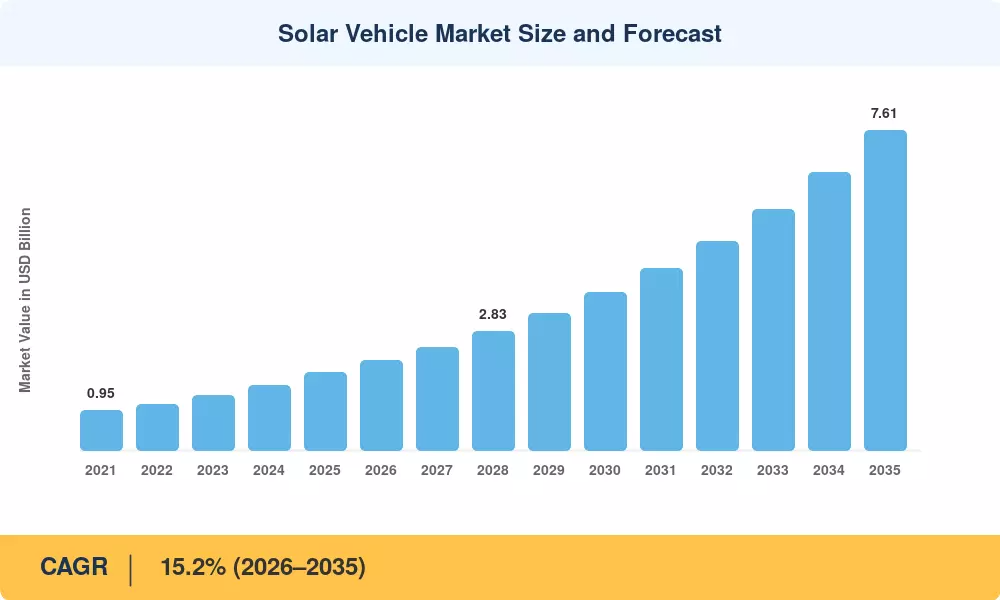
The Solar Vehicle Market reached an estimated USD 1.85 billion in 2025 and is projected to grow from USD 2.13 billion in 2026.
The Solar Vehicle Market reached an estimated USD 1.85 billion in 2025 and is projected to grow from USD 2.13 billion in 2026 to USD 7.61 billion by 2035.”
NEW YORK, NY, UNITED STATES, July 21, 2026 /EINPresswire.com/ -- The Solar Vehicle Market reached an estimated USD 1.85 billion in 2025 and is projected to grow from USD 2.13 billion in 2026 to USD 7.61 billion by 2035, registering a CAGR of 15.2% during the forecast period.— Arti Dhapte
Market Overview
Solar vehicles represent a transformative category of transportation that integrates photovoltaic (PV) cells into vehicle surfaces to convert sunlight directly into electrical energy for propulsion, range extension, or auxiliary power. These vehicles range from passenger cars with solar-integrated roofs to commercial buses, light commercial vehicles, and agricultural machinery equipped with solar panels. By harnessing renewable solar energy, these vehicles offer a sustainable alternative to conventional battery-electric vehicles (BEVs) and internal combustion engine (ICE) vehicles, significantly reducing dependence on grid charging and lowering greenhouse gas emissions.
The market's exceptional growth trajectory is driven by two powerful catalysts: the European Union's revised CO₂ emission standards mandating a 55% reduction for new passenger vehicles by 2030, and China's "New Energy Vehicle Industrial Development Plan (2021–2035)," which allocated over USD 15 billion in subsidies and tax incentives toward zero-emission transport technologies. These policy frameworks have created a durable investment floor beneath the Solar Vehicle Market.
A technological shift is underway as conventional internal-combustion drivetrains give way to photovoltaic-assisted electric powertrains. Automakers are replacing passive roof structures with integrated solar cells capable of generating 1.0–1.5 kW of onboard power, reducing dependence on grid charging by 15–25% annually. BloombergNEF estimates that global investment in solar-integrated mobility exceeded USD 1.2 billion in 2024 alone, signaling that vehicle-integrated photovoltaics (VIPV) have moved from prototype curiosity to industrial procurement line item.
Industry trends indicate a decisive shift toward factory-integrated solar solutions and purpose-built solar vehicles. The transition from rigid, flat glass panels to flexible, lightweight thin-film technologies is expanding design possibilities, enabling integration into curved roofs, hoods, and body panels. The rise of electric vehicles (EVs) and government initiatives to reduce carbon emissions are also driving demand for solar-powered EV charging and auxiliary power systems.
Technological developments are rapidly expanding the market's capabilities. The arrival of perovskite-silicon tandem cells at automotive-grade durability could push vehicle-mounted panel efficiency past 30%, roughly doubling the daily energy harvest from current levels. Oxford PV shipped its first commercial tandem modules in late 2024, and automotive Tier-1 suppliers including Panasonic and CATL are evaluating tandem-cell integration for 2028-model-year vehicles. Thin-film technologies are gaining ground in bus and commercial-vehicle applications where weight savings of 40–60% relative to crystalline silicon panels translate directly into payload capacity.
📍 Get Free Sample Report for Detailed Market Insights:
https://www.marketresearchfuture.com/sample_request/41150
Market Segmentation
By Solar Technology
The market is segmented by solar technology into Monocrystalline Silicon, Thin-Film (CIGS/CdTe), Polycrystalline Silicon, and Multi-Junction / CPV. Monocrystalline silicon solar cells command the largest technology share at approximately 42%, owing to superior conversion efficiency above 22%. Automotive OEMs overwhelmingly specify monocrystalline cells for factory-installed roof panels due to their 22–24% conversion efficiency and 25-year degradation warranties adapted from the rooftop solar industry. Thin-film photovoltaic technology is projected to register a CAGR of 18.4% through 2035, driven by its lightweight profile and curved-surface adaptability. Multi-junction and concentrated photovoltaic cells remain a niche segment, valued at roughly USD 95 million in 2025, primarily serving high-performance prototypes where efficiencies above 35% justify premium costs.
By Vehicle Type
Vehicle type segmentation covers Passenger Cars, Commercial Buses, Light Commercial Vehicles, Agricultural Vehicles, and Others (Boats, Recreational). Passenger cars account for over 48% of the market by revenue, reflecting consumer demand for solar-assisted range extension in personal EVs. Hyundai, Toyota, and Mercedes-Benz each offer or have announced solar roof options for their flagship EV models. Commercial buses represent the fastest-growing vehicle category with a projected CAGR of 17.1%, supported by municipal transit electrification programs across 35+ countries. The larger roof area of a 12-meter city bus (10–15 m²) can host panels generating 4–8 kWh daily—sufficient to power onboard HVAC, lighting, and infotainment systems. Agricultural vehicles represent the highest-growth segment at a CAGR of 19.8%, driven by off-grid farming electrification in emerging markets.
By Application
Application segmentation includes Battery Charging / Range Extension, Auxiliary Power Systems, and Direct Propulsion. Battery charging and range extension holds the largest share at 55%, reflecting the fundamental value proposition of VIPV technology: reducing grid dependence and adding usable daily range. Auxiliary power systems are growing at a CAGR of 14.8%, supporting HVAC, electronics, and cabin pre-conditioning without traction-battery draw. Direct propulsion remains a niche application at USD 0.08 billion in 2025, primarily serving lightweight solar-native vehicle designs.
By Region
Regional segmentation includes North America, Europe, Asia Pacific, South America, and the Middle East and Africa. Asia-Pacific leads with a 38% share, with China alone contributing over half of regional revenue. Europe is expected to grow at a CAGR of 15.8% through 2035. North America generated approximately USD 0.44 billion in 2025, with the U.S. representing 82% of regional demand.
🛒 You can buy this market report at:
https://www.marketresearchfuture.com/checkout?currency=one_user-USD&report_id=41150
Regional Analysis
Asia-Pacific
Asia-Pacific dominates the Solar Vehicle Market with approximately 38% revenue share, driven by aggressive EV mandates in China, Japan, and South Korea. China accounts for 52% of regional revenue, reflecting its position as both the world's largest EV producer and the largest solar cell manufacturer, creating vertical integration advantages no other country can match. BYD, NIO, and Xpeng have each announced VIPV-equipped models for 2026–2027 launch windows, while CATL is developing vehicle-specific thin-film modules targeting bus and logistics-van applications. Japan grows at a CAGR of 14.2%, with Toyota and Honda solar roof commercialization programs. South Korea contributes USD 0.06 billion in 2025, driven by Hyundai's IONIQ solar ecosystem. India is the fastest-growing major market at a CAGR of 19.5%, with FAME-III subsidy extension to solar-assisted EVs driving adoption. Australia contributes 4% of regional revenue, benefitting from high solar irradiance and V2G pilot programs.
Europe
Europe holds the second-largest share at roughly 28%, anchored by stringent fleet-emission regulations and Horizon Europe R&D funding. Germany leads regional demand at 32% of European share, driven by OEM solar integration programs from Mercedes, BMW, and Volkswagen. Germany's Federal Ministry for Economic Affairs allocated EUR 120 million in 2024 for automotive photovoltaic R&D through the "SolarAuto" initiative. The Netherlands grows at a CAGR of 16.8%, with Lightyear successor programs and solar mobility startups. France contributes USD 0.07 billion in 2025, supported by Stellantis VIPV strategy and EU Green Deal alignment. The United Kingdom represents 12% of regional revenue, with OZEV grants extended to solar-equipped EVs. Norway grows at a CAGR of 13.5%, where high EV penetration creates solar-upgrade demand.
North America
North America is the third-largest contributor at 24% share, with the U.S. Department of Energy's Vehicle Technologies Office channeling grants toward solar-assisted EV demonstration programs. The United States accounts for 82% of regional revenue, driven by DOE VTO grants and IRA clean-vehicle credits extending to solar-equipped EVs meeting domestic content thresholds. Aptera Motors and several California-based startups are developing purpose-built solar EVs targeting the Sun Belt market, where annual solar energy harvest per vehicle can exceed 3,000 kWh. Canada grows at a CAGR of 13.9%, with the federal ZEV mandate requiring 100% by 2035. Mexico contributes USD 0.02 billion in 2025, benefitting from nearshoring of EV supply chains.
Rest of the World
The Rest of the World segment, encompassing South America and the Middle East and Africa, presents developing market opportunities. Brazil anchors South American demand with 58% of regional revenue, driven by São Paulo's electric bus mandate requiring 100% zero-emission new public bus acquisitions by 2030. Chile grows at a CAGR of 16.2%, with Atacama-region solar irradiance and mining fleet electrification driving adoption. Colombia contributes USD 0.01 billion in 2025, supported by Bogotá TransMilenio solar-bus pilots. The UAE accounts for 42% of Middle East and Africa regional revenue, driven by NEOM and Dubai smart-city deployments. Saudi Arabia is the fastest-growing market at a CAGR of 19.1%, supported by Vision 2030 clean-transport investments. South Africa contributes USD 0.01 billion in 2025, with off-grid solar vehicle applications.
Competitive Landscape / Key Players
The Solar Vehicle Market is moderately fragmented, with the top five players holding a combined estimated share of 28–35%. Key companies operating in this market include Hyundai Motor Group, Toyota Motor Corp., Sono Group (restructured), Lightyear (successor entity), Aptera Motors, Mercedes-Benz Group, BYD Company, Hanwha Q Cells, Webasto SE, and Panasonic Holdings.
Strategic developments in the market include significant product announcements and strategic pivots. In April 2024, Sono Group completed restructuring and pivoted to B2B licensing of its proprietary solar integration technology, signing agreements with two European commercial-vehicle OEMs. Hyundai Motor Group announced that its IONIQ 5 and IONIQ 6 solar roof option contributed 1,300–1,800 km of annual range recovery in sun-belt climates. Mercedes-Benz has announced a next-generation EQXX derivative program incorporating full-body VIPV coverage targeting a 0.17 drag coefficient combined with 1.2 kW peak solar output.
Competitive differentiation increasingly hinges on cell efficiency, integration capability, weight optimization, and OEM partnerships. The market is characterized by large automotive OEMs integrating VIPV as a feature within broader EV platforms, and specialized solar-vehicle startups building purpose-designed vehicles. Competition is intensifying as Tier-1 automotive suppliers like Panasonic, Webasto, and Hanwha Q Cells enter the VIPV supply chain.
Latest Industry News & Developments
Recent industry developments highlight the ongoing transformation of the solar vehicle market toward commercialization and technological advancement. In January 2025, Aptera announced progress toward market readiness with its production-intent solar electric vehicle, showcasing advancements in solar-only vehicle architectures and specialized aerodynamic design for extended solar range. This development reflects the growing maturity of purpose-built solar EVs.
In June 2025, Swap Robotics received an undisclosed investment from Silicon Ranch to expand solar robotic operations and product development. The company will concentrate on utility-scale solar construction and maintenance technologies that could impact vehicle-integrated photovoltaic manufacturing processes, signaling cross-sector innovation in solar technology deployment.
In April 2024, Sono Group completed restructuring and pivoted to B2B licensing of its proprietary solar integration technology, signing agreements with two European commercial-vehicle OEMs. This strategic shift from consumer vehicle manufacturing to technology licensing reflects a broader trend of specialization and partnership in the Solar Vehicle Market.
Market Challenges & Opportunities
Key restraints facing the solar vehicle market include limited rooftop surface area on vehicles, with the usable rooftop space of a typical passenger automobile around 2.5–4.0 m² limiting peak solar production to 0.8–1.5 kW. High integration costs relative to grid charging, with VIPV roof system installation costs currently between USD 1,500 and USD 3,500 per vehicle, create payback periods exceeding 12 years in markets with low electricity prices. Real-world efficiency losses drop laboratory cell efficiencies of 22–26% to 15–18% under actual driving conditions due to suboptimal panel angles, shading, and thermal losses. Consumer skepticism about range contribution and supply chain constraints for automotive-grade cells further challenge adoption.
Emerging opportunities in the market are substantial and diverse. Perovskite-silicon tandem cell commercialization could push vehicle-mounted panel efficiency past 30%, roughly doubling daily energy harvest. Oxford PV shipped its first commercial tandem modules in late 2024, and automotive Tier-1 suppliers are evaluating integration for 2028-model-year vehicles. Municipal electric bus fleet conversion, with over 600 cities worldwide committed to fully electric public bus fleets by 2035, represents a procurement pipeline exceeding 500,000 buses. Solar roof panels on transit buses generating 4–8 kWh per day create a compelling total-cost-of-ownership argument. Solar-powered agricultural machinery in emerging markets offers high growth potential, with India's FAME-III scheme expected to extend subsidies to agricultural EVs starting in 2026.
Future potential lies in vehicle-to-grid energy monetization, with solar-equipped EVs feeding surplus energy back into the grid generating USD 200–600 annually per vehicle. Aftermarket solar retrofit kits priced at USD 800–2,000 for existing EV models target the 45+ million EVs expected on global roads by 2030. Autonomous solar mobility platforms, with Waymo and Baidu evaluating VIPV integration for next-generation robotaxi platforms, target 15–20% reductions in fleet charging downtime. Platform economics and solar mobility-as-a-service will treat solar-equipped vehicles as mobile energy assets, with IEA projecting V2X energy trading could generate USD 8 billion annually by 2035.
To explore more market insights, visit us at:
https://www.marketresearchfuture.com/reports/solar-vehicle-market-41150
Final Market Summary
The solar vehicle market is positioned for exceptional growth through 2035, driven by stringent fleet-emission regulations, declining photovoltaic cell costs, urban EV charging infrastructure gaps, and increasing consumer demand for energy independence. The projected valuation of USD 7.61 billion reflects rapidly expanding adoption across passenger cars, commercial buses, light commercial vehicles, and agricultural machinery, with the market transitioning from niche prototypes to factory-integrated solutions across mainstream EV platforms.
The medium-term growth outlook remains exceptionally strong, with the market registering a remarkable CAGR of 15.2% during the forecast period. Asia-Pacific will continue to lead market expansion through China's NEV mandates and vertical integration advantages, while Europe maintains significant growth through stringent emission regulations and OEM commitments. The ongoing development of perovskite-silicon tandem cells, thin-film technologies, and vehicle-to-grid integration will continue to expand market possibilities and applications.
Long-term industry potential extends significantly beyond the current forecast horizon. The convergence of regulatory pressure, technological advancement, and changing consumer preferences will continue to reshape the market landscape. The electrification supercycle, with global EV sales forecast to reach 45 million units annually by 2030, presents a massive addressable opportunity if even 8–12% incorporate factory-installed solar panels. ESG reporting and corporate fleet mandates will create durable institutional demand channels for the Solar Vehicle Market. The evolution toward autonomous solar mobility platforms and mobility-as-a-service models will transform vehicles from depreciating assets into mobile energy platforms.
More Related Reports from MRFR Library:
Us Dump Truck Market: https://www.marketresearchfuture.com/reports/us-dump-truck-market-18109
Us Motorcycles Market: https://www.marketresearchfuture.com/reports/us-motorcycles-market-18225
Us Bicycle Market: https://www.marketresearchfuture.com/reports/us-bicycle-market-18226
Us Automotive Head Up Display Market: https://www.marketresearchfuture.com/reports/us-automotive-head-up-display-market-18231
Us Agricultural Tractors Market: https://www.marketresearchfuture.com/reports/us-agricultural-tractors-market-18239
Electric Pickup Vehicle Market: https://www.marketresearchfuture.com/reports/electric-pickup-vehicle-market-19264
Us Automotive Motor Market: https://www.marketresearchfuture.com/reports/us-automotive-motor-market-19587
Us Electric Axle Drive Systems Market: https://www.marketresearchfuture.com/reports/us-electric-axle-drive-systems-market-19633
Yacht Charter Market: https://www.marketresearchfuture.com/reports/yacht-charter-market-20680
Bicycle Frames Market: https://www.marketresearchfuture.com/reports/bicycle-frames-market-21310
Larry Wilson
WantStats Research And Media Pvt. Ltd.
+ +1 855-661-4441
email us here
Visit us on social media:
LinkedIn
Facebook
YouTube
X
Legal Disclaimer:
EIN Presswire provides this news content "as is" without warranty of any kind. We do not accept any responsibility or liability for the accuracy, content, images, videos, licenses, completeness, legality, or reliability of the information contained in this article. If you have any complaints or copyright issues related to this article, kindly contact the author above.
