

Brain Implants Market to reach USD 9.49 Billion by 2035 at 11.2% CAGR
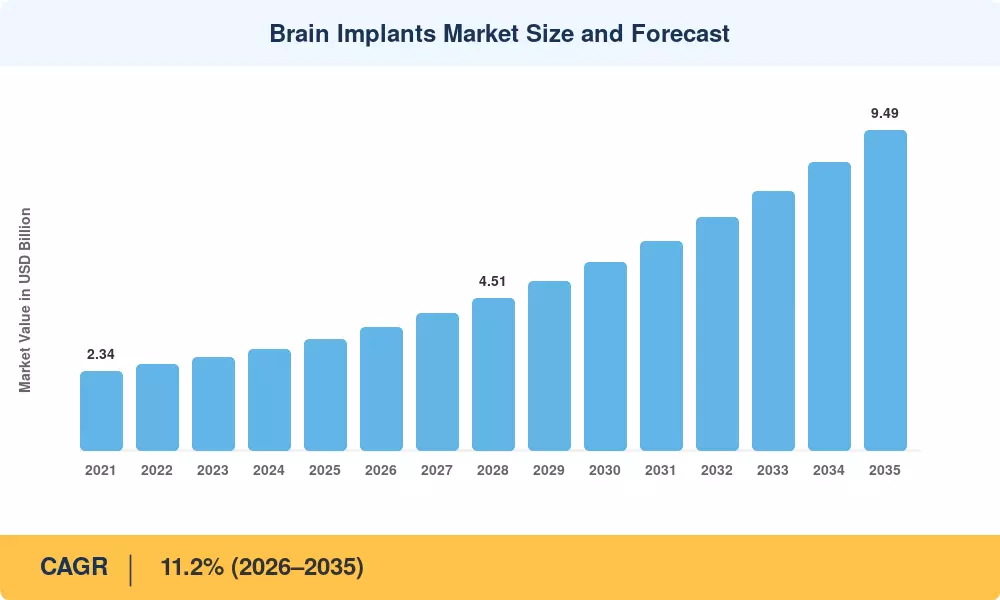
Brain Implants Market Size
Brain Implants Market to Surge from USD 3.65 Billion in 2026 to USD 9.49B by 2035-By Rising Neurological Disease Prevalence, Closed-Loop Adaptive Stimulation
NY, CA, UNITED STATES, July 17, 2026 /EINPresswire.com/ -- As per Market Research Future, the global Brain Implants Market size to reach USD 9.49 Billion by 2035 from USD 3.65 Billion in 2026, at a CAGR of 11.2% during the forecast period 2026--2035. The market base was estimated at USD 3.28 Billion in 2025.The 11.2% CAGR---anchored by structural neurology demand rather than discretionary healthcare spending---is driven by three converging forces: rising global neurological disease prevalence that continues to widen the addressable patient base for neuromodulation therapy, sustained closed-loop adaptive stimulation adoption that has pulled brain implant treatment from palliative symptom management into precision neuromodulation protocols, and regulatory pathway acceleration that has compressed time-to-market for next-generation neurostimulation devices.
National governments and multilateral health organizations are amplifying this momentum. The WHO estimates that over 3.4 billion people globally live with a neurological condition, with Parkinson's disease prevalence alone projected to double by 2040 relative to 2020 levels. The U.S. BRAIN Initiative has committed cumulative funding exceeding USD 3.8 billion since inception, directly accelerating commercial-grade implant development.
The NIH allocated over USD 580 million toward neurotechnology research in fiscal year 2024 alone, signaling sustained institutional commitment to device-based interventions. Since 2020, the FDA's Breakthrough Device Designation program has reduced average review timelines for neurostimulation devices by approximately 35%. Together, these initiatives are creating the clinical infrastructure and delivery innovation on which the Brain Implants Market depends.
Request A Free Sample:
https://www.marketresearchfuture.com/sample_request/6742
Key Market Trends & Growth Drivers
Rising Neurological Disease Prevalence and Extended Survival
The WHO's 2024 global burden of disease update placed neurological conditions as the leading cause of disability worldwide, affecting an estimated 3.4 billion individuals. Parkinson's disease prevalence alone is projected to double by 2040 relative to 2020 levels, directly expanding the addressable patient pool for deep brain stimulation.
This epidemiological trajectory creates structural demand that insulates the Brain Implants Market from cyclical economic pressures. National neurological registries in India and Brazil are also capturing higher detection rates as screening programs mature, feeding into the Brain Implants Market growth pipeline across emerging economies. Each percentage point of neurological disease prevalence gain translates into measurable prescription volume for neuromodulation therapy, and the brain implant treatment schedule embedded in routine neurology care makes this driver structurally durable through 2035.
Extended survival in neurodegenerative conditions---driven by disease-modifying therapies extending median progression-free survival in Parkinson's disease---creates a larger prevalent population requiring sustained neuromodulation therapy. Longer survival transforms Parkinson's disease from a rapid-disability diagnosis into a chronic condition with sustained deep brain stimulation utilization.
Early-adopter health systems report that AI-enhanced intraoperative imaging and robotic stereotactic platforms detect optimal implant targets with sub-millimeter precision, converting patients who would previously have been deemed surgical non-candidates into candidates for precision neuromodulation. Deep-learning algorithms trained on over 2 million neuroimaging datasets now optimize electrode placement and stimulation parameters with clinical outcomes superior to conventional manual programming.
Closed-Loop Adaptive Stimulation
Legacy open-loop stimulation systems, long the default neuromodulation modality, are giving ground to closed-loop adaptive platforms that sense bioelectrical signals in real time and adjust output accordingly. NeuroPace's RNS System demonstrated a 75% median seizure reduction in long-term follow-up studies, establishing proof-of-concept for responsive neurostimulation in drug-resistant epilepsy.
Medtronic's Percept PC platform and Abbott's proprietary sensing algorithms are pushing this paradigm across indications, converting the Brain Implants Market from a static hardware sale to a dynamic, software-upgradable platform model. The NIH allocated over USD 580 million toward neurotechnology research in fiscal year 2024 alone, directly addressing the fundamental science gaps that have constrained adaptive stimulation adoption. FDA Breakthrough Device Designations granted in 2024--2025 shortened time-to-market by approximately 14 months for two closed-loop neurostimulation candidates targeting movement disorders.
Regulatory Pathway Acceleration and Reimbursement Expansion
CMS expanded Medicare reimbursement codes for vagus nerve stimulation in treatment-resistant depression in 2024, adding an estimated 2.1 million eligible U.S. patients to the covered population. European data from health technology assessment bodies show that preventing a single neurological hospitalization saves payers approximately USD 45,000--60,000 per patient.
This economic incentive has driven hospital formulary committees to prioritize preventive neuromodulation protocols, shifting procurement budgets toward the Brain Implants Market at the expense of reactive pharmacological intervention spending. Value-based neurology contracts in the United States and European reference pricing for neurostimulation devices have shifted institutional procurement toward early intervention.
The move from invasive to minimally invasive and non-invasive delivery---as seen with endovascular brain-computer interfaces like Synchron's Stentrode---decreases surgical risk from open craniotomy to endovascular catheterization. Ambulatory surgical centers and specialty neurology clinics are seeing a rising preference for minimally invasive forms due to lower operating costs and higher patient throughput.
Ask for Customization:
https://www.marketresearchfuture.com/ask_for_customize/6742
Market Segment Insights
BY PRODUCT TYPE
Deep Brain Stimulators: Dominant segment with ~42% revenue share in 2025. Reflecting entrenched physician familiarity with Medtronic Percept PC and Abbott Infinity platforms. Deep brain stimulation, supported by decades of clinical evidence in Parkinson's disease management, anchors institutional formularies globally due to its established efficacy and growing adoption for essential tremor and dystonia. Hospital procurement teams treat it as a default first-line neuromodulation intervention, and the transition to directional leads---which steer current more precisely to target structures---is driving upgrade cycles among existing patient populations even in cost-sensitive emerging markets.
Vagus Nerve Stimulators: Fastest-growing product segment at 12.8% CAGR (2026--2035). Driven by expanded indications beyond epilepsy into depression and cluster headaches. LivaNova's SenTiva system generated strong 2024--2025 revenue, and pipeline candidates targeting treatment-resistant depression and post-traumatic stress disorder could double the segment's addressable population by 2030. The convergence of diagnostic neural biomarkers with matched therapeutic vagus nerve stimulation is creating theranostic platforms that personalize neuromodulation at scale.
Spinal Cord Stimulators: USD 1.04 Billion in 2026. High-frequency (10 kHz) and burst stimulation paradigms have expanded the clinical evidence base beyond traditional paresthesia-based therapies, attracting new patient referrals from pain management physicians who previously relied solely on pharmacological approaches. Nevro's Senza HFX platform anchors this segment with demonstrated superiority in failed back surgery syndrome.
BY APPLICATION
Parkinson's Disease: Dominant application with ~35% revenue share in 2025. An estimated 8.5 million global patients and growing make deep brain stimulation a near-universal component of advanced care pathways for movement disorders. The inherent progression of dopaminergic neuron loss drives sustained dual-channel demand for neuromodulation devices.
Epilepsy: Fastest-growing application segment at 12.4% CAGR (2026--2035). Reflecting the RNS System's demonstrated efficacy in drug-resistant focal epilepsy and expanding closed-loop responsive neurostimulation indications. NeuroPace's five-year real-world outcomes data showing sustained 75% median seizure reduction create a larger prevalent population requiring long-term implant management.
Chronic Pain: USD 0.91 Billion in 2026. The opioid crisis across North America and Europe has created a strong policy push toward non-pharmacological pain interventions, directly benefiting spinal cord stimulation adoption. High-frequency and burst paradigms anchor this segment with demonstrated clinical superiority.
Mental Disorders: 7.4% market share in 2025. Deep brain stimulation is currently being assessed in clinical trials for obsessive-compulsive disorder, major depressive disorder, and post-traumatic stress disorder. Successful Phase III results in any of these indications would significantly expand the addressable patient pool beyond the current movement disorder and pain management core.
BY TECHNOLOGY
Minimally Invasive: Dominant technology with ~45% revenue share in 2025. Surgeons and patients favor reduced operative risk and faster recovery times. Robotic-assisted stereotactic platforms have improved targeting accuracy for minimally invasive implantations, narrowing the precision gap with fully invasive approaches.
Non-Invasive: Fastest-growing technology segment at 13.1% CAGR (2026--2035). Patient preference and outpatient delivery models drive demand. Transcranial magnetic stimulation and focused ultrasound platforms require no surgical intervention, enabling brain implant treatment in community clinics lacking neurosurgical capacity.
BY END USER
Hospitals & Neurosurgical Centers: Largest segment with ~72% share in 2025. Comprehensive neurology service lines and implantation infrastructure requirements dominate volume. Hospitals remain the primary delivery site for brain implant treatment with deep brain stimulators due to operating room infrastructure, neuroimaging equipment, and multidisciplinary clinical team requirements.
Specialty Clinics: Fastest-growing end-user segment at 12.9% CAGR (2026--2035). Outpatient shift and cost optimization drive demand as minimally invasive and non-invasive neuromodulation reduces the need for supervised surgical admission. Specialty clinics focused on pain management and epilepsy are increasingly prescribing brain implant treatment options to manage hospital capacity.
Read Detailed Insights:
https://www.marketresearchfuture.com/reports/brain-implants-market-6742
Regional Outlook
North America -- Dominant Market (~38% Share, 2025)
The United States generates approximately 82% of North American Brain Implants Market revenue, driven by entrenched reimbursement frameworks, over 600 hospitals with active neuromodulation programs, and the most mature insurance reimbursement pathways globally. CMS billing code expansions in 2024--2025 broadened covered indications for both DBS and VNS, directly widening the eligible patient funnel---a single policy ecosystem that converted a specialty-surgery-dominated market into one with a structural preventive neuromodulation tail. CMS reimbursement for neurostimulation devices under the hospital outpatient prospective payment system has driven adoption in academic medical centers, while community neurology networks increasingly prescribe minimally invasive brain implant treatment options to manage surgical waitlist capacity. The US dominates through a combination of high per-patient spending, robust payer coverage, and rapid closed-loop adoption.
Canada contributes through provincial health authority device adoption programs at 10.5% CAGR, while Mexico is growing at steady pace on private hospital chain expansion at USD 0.04 Billion in 2026. North America's leadership rests on reimbursement depth and the structural closed-loop segment created by expanded CMS compliance mandates and value-based neurology contracts.
Europe -- Second Largest (~USD 0.99 Billion, 2026)
Europe's Brain Implants Market reflects divergent national strategies---Germany leads regionally with a strong MedTech R&D ecosystem and DRG-based reimbursement, contributing ~24% of regional share in 2025, while the UK historically used selective neuromodulation targeting before broadening coverage through NHS Long Term Plan neurology investment at 10.9% CAGR. France contributes ~18.5% of regional share through Plan France 2030 neuroscience research commitments. Italy contributes ~14% on expanding epilepsy surgery center network adoption. Spain is growing at 10.2% CAGR on public hospital modernization.
Harmonization pressure from the EU Medical Device Regulation (MDR) framework is gradually narrowing these differences, lifting baseline demand across the region. The European Commission's Pharmaceutical Strategy mandates equitable access to neurology medicines, including brain implant treatment across all member states. The Nordic countries hold ~8% of regional share on high per-capita healthcare spending. Russia contributes USD 0.04 Billion on government neurotechnology programs. Centralized health technology assessment bodies---NICE, G-BA, and HAS---have progressively widened reimbursement for neurostimulation devices across indications.
Asia-Pacific -- Fastest-Growing Region (13.4% CAGR, 2026--2035)
Asia-Pacific is the engine of the Brain Implants Market. China holds the largest regional share with ~36% of regional revenue, driven by Healthy China 2030 initiative and NMPA expedited review channels for innovative Class III neurological devices. India is growing at 14.8% CAGR on the back of Ayushman Bharat tertiary hospital expansion and NABH-accredited neurosurgical center growth. Japan contributes USD 0.19 Billion through NHI coverage expansion for DBS at steady pace. South Korea is growing at 12.6% CAGR on advanced healthcare IT infrastructure and HIRA neuromodulation reimbursement reform.
Middle East & Africa -- Emerging Opportunity (~6% Share, 2025)
The Middle East & Africa is bifurcated between well-funded Gulf states and resource-constrained Sub-Saharan nations. Saudi Arabia leads the region with Vision 2030 healthcare cluster development, contributing ~29% of regional share---NEOM health cluster and dedicated neuroscience centers in Riyadh and Jeddah have created pockets of excellence for brain implant treatment. The UAE is growing at 11.8% CAGR on medical tourism for neuromodulation procedures, with Cleveland Clinic Abu Dhabi and other international hospital brands offering neurostimulation services.
Competitive Landscape and Recent Developments
The Brain Implants Market exhibits medium concentration, with the top five companies holding an estimated 60--65% combined revenue share. The Herfindahl-Hirschman Index sits in the 1,200--1,400 range, reflecting a mix of multinational medical device conglomerates and specialized neurotechnology firms. Patent expirations and next-generation platform entry are gradually fragmentating legacy open-loop segments, though pipeline innovation in closed-loop adaptive systems sustains competitive moats for first-movers. Barriers to entry are substantial given regulatory complexity, clinical evidence requirements, and surgeon training investment.
The competitive landscape is stratified between deep brain stimulation pioneers serving global neuromodulation markets, closed-loop adaptive platform specialists capturing next-generation tenders, and brain-computer interface developers consolidating the emerging neuroprosthetic segment.
KEY COMPANIES AND RECENT MILESTONES
Medtronic plc (2024--2025): Maintains leadership with the Percept PC DBS system and SureTune programming platform, commanding ~18--22% of global Brain Implants Market revenue. First-mover in integrated sensing and stimulation with global neuromodulation leadership. Premium platform positioning in specialty segments offsets price compression in competitive markets.
Abbott Laboratories (March 2024): Launched the NeuroSphere Virtual Clinic platform for remote DBS programming, enabling clinician-patient sessions without in-office visits. Directional lead and sensing technology anchors a strong global franchise, holding ~14--17% of global revenue. The company benefits from the structural closed-loop tail created by expanded adaptive stimulation pipeline investment.
Boston Scientific (2024--2025): Vercise Genus DBS and WaveWriter SCS platforms reinforce the high-frequency and multi-waveform stimulation positioning, holding ~11--14% of global revenue. Advanced waveform programming and multi-site stimulation reinforce the precision neuromodulation for brain implant treatment positioning.
LivaNova PLC (2024--2025): SenTiva VNS system reinforces the vagus nerve stimulation specialist positioning, holding ~7--9% of global revenue. Expanded psychiatric indications and miniaturized pulse generator design reinforce the leveraging scale for neurostimulation access positioning.
Future Outlook: 2026--2035
By 2030, precision closed-loop theranostics will become the operating system of brain implant management. The convergence of companion diagnostics and targeted adaptive stimulation will reshape the Brain Implants Market through the late 2020s. By 2030, an estimated 40% of newly diagnosed drug-resistant epilepsy patients will undergo biomarker-guided staging followed by matched responsive neurostimulation therapy, creating a diagnostic-therapeutic revenue loop. The NIH's USD 580 million annual neurotechnology investment ensures domestic adaptive algorithm supply scales alongside clinical demand.
Machine-learning models that integrate genomic, proteomic, and neural signal biomarkers can recommend optimal sequencing of deep brain stimulation, vagus nerve stimulation, and spinal cord stimulation for individual patients. Start-ups have raised over USD 800 million in venture funding for neurology decision-support tools since 2023.
More Related Research Insights:
https://www.marketresearchfuture.com/reports/cutaneous-b-cell-lymphoma-treatment-market-12151
https://www.marketresearchfuture.com/reports/deep-brain-stimulation-device-market-43622
https://www.marketresearchfuture.com/reports/dental-liners-bases-market-43252
https://www.marketresearchfuture.com/reports/dental-obturators-market-43242
https://www.marketresearchfuture.com/reports/dialysis-services-market-43647
https://www.marketresearchfuture.com/reports/diet-pills-market-43629
https://www.marketresearchfuture.com/reports/differentiated-thyroid-cancer-therapeutics-market-43230
https://www.marketresearchfuture.com/reports/digestive-supplements-market-43613
https://www.marketresearchfuture.com/reports/direct-anterior-approach-market-66508
https://www.marketresearchfuture.com/reports/disinfectant-robot-market-40973
Larry Wilson
WantStats Research And Media Pvt. Ltd.
+1 855-661-4441
email us here
Visit us on social media:
LinkedIn
Facebook
YouTube
X
Legal Disclaimer:
EIN Presswire provides this news content "as is" without warranty of any kind. We do not accept any responsibility or liability for the accuracy, content, images, videos, licenses, completeness, legality, or reliability of the information contained in this article. If you have any complaints or copyright issues related to this article, kindly contact the author above.
