

Autonomous Mobile Robot Market Projected to Hit USD 5.54 Billion in 2026 and USD 18.30 Billion by 2035, CAGR 14.2%
Autonomous Mobile Robot Market
Autonomous Mobile Robot Market Size, Share and Research Report By Offering (Hardware, Software & Services), By Technology (Laser/LiDAR, Vision Guidance, Others)
The Autonomous Mobile Robot Market is accelerating with increasing automation in warehouses, manufacturing facilities, and logistics operations.”
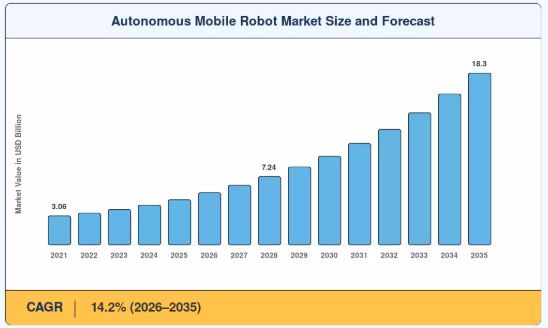
BERLIN, BERLIN, GERMANY, July 1, 2026 /EINPresswire.com/ -- The Global autonomous mobile robot market was valued at USD 4.81 billion in 2025 and is projected to grow from USD 5.54 billion in 2026 to USD 18.30 billion by 2035, registering a CAGR of 14.2% during the forecast period. Two major catalysts are accelerating this trajectory: persistent labor shortages across warehousing and manufacturing sectors in OECD economies, where vacancy rates for warehouse operations exceeded 4.8% in the United States during 2024, and aggressive government incentive programs including the European Union’s “Factory of the Future” grants and China’s “Made in China 2025” robotics subsidies that substantially reduce capital-expenditure barriers for mid-sized adopters. — Market Research Future (MRFR)
With over 80% of large warehouses now implementing automation solutions, operators face mounting pressure to modernize intralogistics or risk competitive disadvantage.
Legacy manually-guided vehicle fleets and fixed conveyor infrastructure are rapidly giving way to software-defined, sensor-fused AMR platforms with real-time path planning capabilities. The total cost of ownership for AMR fleets declined approximately 18% from 2021 levels as lithium-ion battery prices dropped below USD 140 per kWh by 2024. Concurrently, advancements in 5G-Advanced connectivity enabling centralized fleet orchestration at sub-10-millisecond latencies have made multi-robot coordination at scale within brownfield facilities commercially viable for mid-market operators for the first time.
Get Full PDF Sample Copy of Report: (Including Full TOC, List of Tables & Figures, Chart) @
https://www.marketresearchfuture.com/sample_request/13407
➤ How Significant Is the Autonomous Mobile Robot Market’s Growth?
The autonomous mobile robot market has demonstrated consistent and robust expansion over recent years. Driven by increasing automation across warehousing, manufacturing, healthcare, and retail sectors, the market is expected to nearly quadruple over the next decade. Rising e-commerce order volumes, labor cost inflation, and the maturation of AI-powered navigation technologies have created acute demand for flexible, scalable AMR deployments.
The goods-to-person picking robots segment accounted for the largest revenue share in 2025, reflecting rapid growth in e-commerce fulfillment where these systems significantly improve picking accuracy and throughput by bringing items directly to workers, reducing travel time and labor intensity. Healthcare facilities are projected to register the fastest end-user CAGR at 17.4% over the forecast period, fueled by pharmacy automation and intra-hospital delivery mandates. Asia-Pacific leads adoption with approximately 39.8% revenue share in 2025, driven by Chinese integrators combining competitive hardware pricing with in-house navigation stacks.
➤ What Does the Future Hold for the Autonomous Mobile Robot Market?
Artificial intelligence and machine learning stand at the forefront of the market’s next growth phase. AI-driven AMR platforms are transforming intralogistics from a manually intensive, fixed-infrastructure operation into a dynamic, data-intelligent automation model. Predictive path-planning algorithms now assess real-time environmental conditions, fleet utilization, and task priority queues to maximize throughput — enabling operators to deploy adaptive robot fleets that respond to demand fluctuations without infrastructure reconfiguration.
The emergence of humanoid platforms represents the most disruptive long-term force reshaping the market’s future. Humanoid robots, projected to grow at a 17.1% CAGR through 2035, can navigate human-designed spaces without facility layout changes, promising fleet simplification because a single platform can switch roles from shelving to sorting to picking. Vision-based navigation systems, expected to expand at 18.9% CAGR through 2035, are eliminating expensive LiDAR sensors through declining camera-module costs and edge-AI chip advances, widening the addressable market for mid-market operators.
The Robot-as-a-Service (RaaS) subscription model is also redefining deployment preferences. While penetration remains below 15% of new deployments globally, RaaS eliminates prohibitive upfront capital requirements for small-to-mid-size operators, offering elastic scalability, faster technology refresh cycles, and predictable operational expenditure highly attractive attributes in an environment where AMR technology is evolving rapidly.
➤ Who Are the Key Players in the Autonomous Mobile Robot Market?
The autonomous mobile robot landscape is characterized by a mix of established industrial automation conglomerates, specialist AMR vendors, and emerging AI-native robotics startups. Key participants shaping the competitive dynamics include:
★KUKA AG — providing advanced industrial and mobile robotics solutions with a leading 12.4% market share in 2025.
★Mobile Industrial Robots (MiR / Teradyne) — delivering configurable AMR platforms for manufacturing and logistics intralogistics applications.
★Geek+ — offering AI-powered goods-to-person systems and sorting robots widely deployed across Asia-Pacific e-commerce fulfillment networks.
★Locus Robotics — pioneering the RaaS model for warehouse fulfillment, having surpassed 5 billion picked items through its collaborative AMR fleet.
★OMRON Corporation — integrating AMR capabilities within broader factory automation and sensing platforms.
★Zebra Technologies (Fetch Robotics) — targeting flexible intralogistics automation with cloud-managed robot fleets for distribution centers.
★Boston Dynamics — advancing legged and mobile manipulation robotics for demanding industrial and inspection environments.
★Hikrobot — serving global logistics and manufacturing customers with a broad portfolio of AMR and sorting robot solutions.
Competition in the market is intensifying as vendors race to embed generative AI and large language model capabilities into fleet orchestration software, expand hardware portfolios to include humanoid platforms, and deepen integrations with warehouse management systems and ERP platforms. Strategic acquisitions, channel partnerships with system integrators, and NVIDIA’s Isaac GR00T foundation model launched in March 2025 to provide a hardware-agnostic platform for accelerating AMR and humanoid development are reshaping the competitive landscape.
➤ What Are the Emerging Trends in the Autonomous Mobile Robot Market?
Several transformational trends are redefining how the autonomous mobile robot market evolves through 2035:
AI & Machine Learning Integration: Predictive path planning, simultaneous localization and mapping (SLAM), and computer vision capabilities are becoming standard features rather than premium add-ons, enabling fleets to navigate dynamic environments without pre-mapped infrastructure.
Humanoid Platform Commercialization: Humanoid robots are advancing from pilot deployments toward scaled production, with Amazon already piloting humanoid couriers that load parcels from Rivian electric vans, signaling potential outdoor extension of AMR applications.
5G-Advanced Fleet Orchestration: Sub-10-millisecond latency slicing enables cloud-native fleet management at scale within large warehouse environments, eliminating the need for on-premises compute infrastructure and lowering deployment complexity for mid-sized operators.
Vision-Based Navigation Adoption: Declining camera-module costs and edge-AI processing advances are enabling vision-based AMRs to deliver LiDAR-equivalent accuracy at substantially lower capital outlay, democratizing adoption across cost-sensitive verticals.
Healthcare Automation Expansion: Intra-hospital delivery, pharmacy automation, and specimen transport applications are driving the fastest end-user CAGR in the market as healthcare facilities invest in autonomous logistics to reduce labor costs and minimize cross-contamination risks.
Robot-as-a-Service (RaaS) Models: Subscription-based deployment models are progressively eliminating upfront capital barriers for SMEs, with leading operators like Locus Robotics demonstrating the scalability and financial viability of pay-per-pick and fleet-as-a-service pricing structures.
Get access to the full description of the report @
https://www.marketresearchfuture.com/reports/autonomous-mobile-robot-market-13407
➤ How Is the Autonomous Mobile Robot Market Segmented?
The autonomous mobile robot market report provides a comprehensive segmentation framework:
By Offering: Hardware, Software & Services
By Technology: Laser/LiDAR, Vision Guidance, Others
By Navigation Type: LiDAR SLAM, Vision-Based, Hybrid Sensor Fusion
By Robot Type: Unmanned Ground Vehicles, Humanoid Robots, Unmanned Aerial Vehicles, Marine Robots
By End-User Industry: E-Commerce & Warehousing, Manufacturing, Healthcare, Retail, Food & Beverage, Logistics
By Payload Capacity: Below 100 kg, 100–500 kg, 500–1,000 kg, Above 1,000 kg
➤ What Are the Regional Insights from the Autonomous Mobile Robot Market?
Asia-Pacific commands approximately 39.8% of global autonomous mobile robot market share, underpinned by Chinese integrators who combine competitive hardware pricing with in-house navigation stacks, alongside strong government manufacturing modernization mandates and expanding e-commerce logistics infrastructure. The region’s advanced semiconductor and electronics manufacturing ecosystem further reinforces its leading position, with companies like Geek+ and Hikrobot capturing significant global market share from their domestic base.
North America holds the second-largest share at approximately 28%, driven by early adoption of humanoid platforms, acute labor shortages in logistics and manufacturing, and robust e-commerce fulfillment throughput requirements. The United States remains the single largest national market, with warehouse vacancy rates exceeding 4.8% creating structural demand pull for autonomous material handling. The region also benefits from a mature venture capital ecosystem supporting next-generation AMR startups.
Europe holds the third-largest share, with Germany, France, and the United Kingdom representing the primary markets. The European Commission’s multi-billion-euro allocations through Horizon Europe and Factory of the Future initiatives are systematically accelerating smart manufacturing adoption. EU workplace safety regulations and the region’s advanced automotive and precision manufacturing sectors further drive AMR procurement across brownfield facilities.
The Middle East and Africa region is projected to register the highest CAGR at approximately 16.9% through 2035. Mega-project logistics requirements in Saudi Arabia and the UAE — associated with Vision 2030 infrastructure programs and smart city development — are creating substantial demand for heavy-duty autonomous material handling systems. Mobile-money proliferation and fintech-led logistics modernization across Africa’s emerging markets represent a complementary long-term demand driver.
South America and remaining global markets, led by Brazil and Mexico, round out the global picture, with cross-border e-commerce growth and nearshoring manufacturing trends driving incremental AMR procurement as operators seek to build resilient, automated supply chains closer to North American end consumers.
➤➤➤ Regional & Country-Level Reports by Market Research Future:
US Autonomous Mobile Robot Market -
https://www.marketresearchfuture.com/reports/us-autonomous-mobile-robot-market-19174
➤➤➤ Industry Analysis Reports by Market Research Future:
Wearable Technology Components Market
https://www.marketresearchfuture.com/reports/wearable-technology-components-market-800
Ambient Assisted Living Market
https://www.marketresearchfuture.com/reports/ambient-assisted-living-market-1015
Next-Generation Power Semiconductors Market
https://www.marketresearchfuture.com/reports/next-generation-power-semiconductors-market-1079
Hybrid Battery Energy Storage System Market
https://www.marketresearchfuture.com/reports/hybrid-battery-energy-storage-system-market-1085
Tablet & Notebook Display Market
https://www.marketresearchfuture.com/reports/tablet-notebook-display-market-1179
Digital Signal Processor Market
https://www.marketresearchfuture.com/reports/digital-signal-processors-dsp-market-1229
Bring Your Own Device Market
https://www.marketresearchfuture.com/reports/bring-your-own-device-market-1286
Next Generation Data Storage Technologies Market
https://www.marketresearchfuture.com/reports/next-generation-data-storage-technologies-market-1800
Robotic Vision Market
https://www.marketresearchfuture.com/reports/robotic-vision-market-1849
Industry Controls And Factory Automation Market
https://www.marketresearchfuture.com/reports/industry-controls-factory-automation-market-1869
Sagar Kadam
Market Research Future
+ + +1 628-258-0071
email us here
Visit us on social media:
LinkedIn
Facebook
YouTube
X
Legal Disclaimer:
EIN Presswire provides this news content "as is" without warranty of any kind. We do not accept any responsibility or liability for the accuracy, content, images, videos, licenses, completeness, legality, or reliability of the information contained in this article. If you have any complaints or copyright issues related to this article, kindly contact the author above.
