

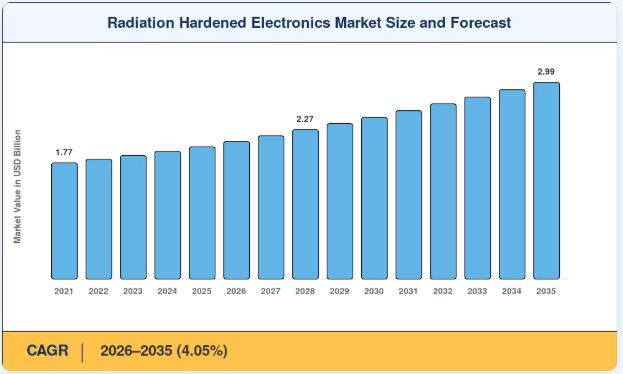
Radiation Hardened Electronics Market Valued at USD 2.99 Billion, Growing at a CAGR of 4.05% during 2026–2035
Radiation Hardened Electronics Market
Radiation Hardened Electronics Market Size, Share and Research Report By EndUser (Space, Aerospace & Defense, Nuclear Power, Industrial & Medical), By Component
The radiation hardened electronics market is rising steadily due to growing space missions, defense applications, and the need for reliable electronics in extreme environments.”
HWASEONG, GYEONGGI-DO, SOUTH KOREA, June 24, 2026 /EINPresswire.com/ -- The Global radiation hardened electronics market reached an estimated USD 2.01 billion in 2025 and is projected to grow from USD 2.09 billion in 2026 to USD 2.99 billion by 2035, registering a CAGR of 4.05% during the forecast period. — Market Research Future (MRFR)
Two major catalysts are accelerating this trajectory: the unprecedented surge in commercial and government satellite launches with over 2,800 satellites deployed in 2024 alone across LEO mega-constellations and intensifying global defense modernization programs that require radiation-tolerant avionics, communications, and guidance electronics for next-generation military platforms. With space economy investment surpassing USD 600 billion globally and nuclear power capacity expansion accelerating across multiple regions, radiation hardened electronics have become indispensable infrastructure components rather than niche aerospace specialty products.
Legacy radiation-hardened-by-process (RHBP) manufacturing techniques are increasingly being supplemented by radiation-hardened-by-design (RHBD) methodologies that achieve comparable single-event-upset (SEU) immunity and total-ionizing-dose (TID) tolerance using commercial semiconductor fabrication nodes.
A recent NASA Goddard Space Flight Center assessment estimated that RHBD-based components can reduce qualification costs by 30–40% compared with traditional rad-hard foundry processes while maintaining mission-critical reliability for LEO and even some GEO applications. This shift is not incremental it reflects a structural re-architecture of how the industry balances radiation tolerance, performance, cost, and time-to-orbit across defense, space, and nuclear end markets.
Get Full PDF Sample Copy of Report: (Including Full TOC, List of Tables & Figures, Chart) @
https://www.marketresearchfuture.com/sample_request/21898
➤ How Significant Is the Radiation Hardened Electronics Market’s Growth?
The radiation hardened electronics market has demonstrated strong and accelerating expansion, rising from approximately USD 2,089.3 million in 2021 to an estimated USD 2.01 billion in 2025, representing a robust historical growth trajectory. The market is projected to more than double over the next decade, propelled by the proliferation of small satellite constellations for broadband connectivity and Earth observation, expanding deep space exploration programs, and rising defense electronics spending across NATO members and Indo-Pacific allied nations responding to evolving geopolitical threat environments.
Rising demand for resilient, radiation-tolerant components in nuclear power plant instrumentation and control systems, growing investment in next-generation missile defense and hypersonic weapons guidance electronics, and the commercial space sector’s shift toward mega-constellation architectures requiring thousands of rad-tolerant satellite buses have created sustained demand across multiple end markets simultaneously. Semiconductor foundries, defense primes, and specialized rad-hard component manufacturers are all expanding production capacity to meet order backlogs that, for some certified rad-hard product lines, now extend 18–24 months.
➤ What Does the Future Hold for the Radiation Hardened Electronics Market?
Advanced semiconductor process nodes and heterogeneous integration stand at the forefront of the market’s next growth phase. Foundries are increasingly qualifying rad-hard variants at 28nm, 16nm, and even sub-10nm process geometries a dramatic leap from the 90nm-180nm legacy nodes that dominated rad-hard production for over a decade. This miniaturization is enabling radiation-tolerant FPGAs, processors, and memory devices with substantially higher compute density and lower power consumption, critical for mass- and power-constrained smallsat and cubesat platforms.
The commercial space sector’s shift toward New Space business models is another defining force reshaping the market’s future. Unlike traditional government space programs that demanded the highest TID and SEU tolerance thresholds regardless of cost, commercial LEO constellation operators are driving demand for “good enough” radiation tolerance components qualified for the specific, more benign radiation environment of low Earth orbit at a fraction of the cost of full military/space-grade parts. This bifurcation is creating distinct market tiers: ultra-high-reliability components for deep space, GEO, and strategic defense missions, and cost-optimized rad-tolerant components for LEO mega-constellations.
Artificial intelligence and machine learning workloads are also beginning to migrate into space and defense platforms, driving demand for rad-hard AI accelerators and edge processing chips capable of onboard data analysis, autonomous decision-making, and real-time sensor fusion without relying on ground-station bandwidth. Several leading rad-hard semiconductor vendors have already introduced radiation-tolerant neural processing units (NPUs) specifically engineered for satellite-based image recognition, signal intelligence, and autonomous spacecraft operations.
➤ Who Are the Key Players in the Radiation Hardened Electronics Market?
The radiation hardened electronics landscape is characterized by a concentrated group of specialized semiconductor manufacturers, defense electronics primes, and emerging RHBD-focused startups. Key participants shaping the competitive dynamics include:
★BAE Systems — a leading provider of radiation-hardened microelectronics including RAD5500 and RAD750 processor families widely used in NASA and defense space missions
★Honeywell International Inc. — offering radiation-hardened FPGAs, microcontrollers, and power management ICs for aerospace, defense, and space applications
★Microchip Technology (formerly Microsemi/Atmel) — providing an extensive portfolio of rad-hard and rad-tolerant FPGAs, memory, and analog/mixed-signal components for space-grade electronics
★Texas Instruments — delivering radiation-hardened and enhanced plastic (EP) qualified analog, power, and interface ICs for satellite and defense electronics platforms
★STMicroelectronics — manufacturing radiation-tolerant microcontrollers and power devices targeting European Space Agency missions and commercial smallsat platforms
★Cobham Advanced Electronic Solutions — specializing in rad-hard RF, microwave, and mixed-signal components for satellite communications and defense electronics
★Renesas Electronics Corporation — providing radiation-tolerant microcontrollers and SoCs supporting Japanese and international space agency programs
★Infineon Technologies AG — offering radiation-hardened power semiconductors and sensor ICs for satellite and nuclear instrumentation applications
★Vorago Technologies — a specialized RHBD pure-play developing radiation-hardened microcontrollers and analog-to-digital converters using commercial CMOS processes
★Frontgrade Technologies (formerly Cobham SemiConductor Solutions) — delivering rad-hard FPGAs, processors, and memory products purpose-built for space and strategic defense missions
Competition in the market is intensifying as vendors race to qualify advanced process nodes for radiation tolerance, expand foundry partnerships to address persistent rad-hard semiconductor capacity constraints, and develop integrated rad-hard system-on-chip (SoC) solutions that reduce component count and total mass for satellite and defense electronics designers. Strategic government funding programs, including the U.S. Department of Defense’s Trusted Foundry initiative and the European Space Agency’s strategic autonomy procurement policies, continue to shape vendor qualification pathways and supply chain security priorities.
➤ What Are the Emerging Trends in the Radiation Hardened Electronics Market?
Several transformational trends are redefining how the radiation hardened electronics market evolves through 2035:
Radiation-Hardened-by-Design (RHBD) Adoption: Design-level radiation mitigation techniques applied to commercial fabrication processes are reducing costs and accelerating time-to-market compared with traditional dedicated rad-hard foundry processes.
LEO Mega-Constellation Demand Surge: The explosive growth of broadband, Earth observation, and IoT satellite constellations is creating massive volume demand for cost-optimized, radiation-tolerant (rather than full mil-spec rad-hard) components.
Advanced Node Migration: Qualification of rad-hard components at 28nm, 16nm, and below is enabling higher performance, lower power consumption, and greater on-board processing capability for mass- and power-constrained space platforms.
AI at the Edge for Space & Defense: Radiation-tolerant AI accelerators and neural processing units are enabling onboard autonomous decision-making, image recognition, and sensor fusion without dependency on ground-station connectivity.
Nuclear Sector Modernization: Aging nuclear power plant instrumentation and control systems are being upgraded with radiation-hardened digital electronics, supported by life-extension programs and new advanced reactor and SMR (small modular reactor) deployments globally.
Supply Chain Security & Trusted Sourcing: Heightened geopolitical tensions and defense procurement policy are driving demand for domestically sourced, trusted-foundry rad-hard components, reshaping vendor qualification and government contracting priorities.
Get access to the full description of the report @
https://www.marketresearchfuture.com/reports/radiation-hardened-electronics-market-21898
➤ How Is the Radiation Hardened Electronics Market Segmented?
The radiation hardened electronics market report provides a comprehensive segmentation framework:
By Component Type: Microprocessors & Microcontrollers, FPGAs, Memory Devices, Power Management ICs, Analog & Mixed-Signal ICs, RF & Microwave Components
By Radiation Hardening Technique: Radiation-Hardened-by-Process (RHBP), Radiation-Hardened-by-Design (RHBD)
By Application: Satellites & Space Exploration, Military & Defense Electronics, Nuclear Power Instrumentation, Medical Equipment, Industrial & Avionics Systems
By End User: Government & Defense Agencies, Commercial Space Operators, Nuclear Power Utilities, Aerospace & Defense Primes
By Orbit Type: Low Earth Orbit (LEO), Medium Earth Orbit (MEO), Geostationary Orbit (GEO), Deep Space
➤ What Are the Regional Insights from the Radiation Hardened Electronics Market?
North America commands approximately 41% of global radiation hardened electronics market share, underpinned by NASA’s extensive deep space and Artemis program procurement, the U.S. Department of Defense’s substantial space and missile defense electronics budgets, and the concentration of leading rad-hard semiconductor manufacturers including BAE Systems, Honeywell, and Microchip headquartered in the United States. The region’s dominance is further reinforced by a dense ecosystem of commercial space companies driving LEO constellation deployment and associated rad-tolerant component demand.
Europe holds the second-largest share at approximately 24%, with France, Germany, and the United Kingdom representing the primary markets. The European Space Agency’s strategic autonomy initiatives, aimed at reducing dependency on non-European rad-hard component suppliers, combined with growing defense electronics investment across NATO member states amid heightened regional security concerns, are driving sustained demand for domestically qualified radiation-hardened components.
Asia-Pacific represents the fastest-growing region, fueled by China’s aggressive satellite constellation and space station expansion programs, India’s ISRO-led space exploration and defense electronics initiatives, and Japan and South Korea’s growing investment in indigenous rad-hard semiconductor capabilities. The region’s expanding nuclear power generation capacity, particularly across China and India, is also creating incremental demand for radiation-hardened instrumentation and control electronics.
The Middle East is emerging as a notable growth market, driven by the UAE’s ambitious space program including the Hope Mars Mission and growing satellite manufacturing capabilities alongside Saudi Arabia’s expanding defense electronics and space sector investments under its Vision 2030 economic diversification strategy.
Latin America rounds out the global picture, with Brazil representing the most active market through its growing satellite launch capabilities and partnerships with international space agencies. While the region’s radiation hardened electronics demand remains modest relative to other geographies, expanding earth observation and telecommunications satellite programs are expected to create incremental growth opportunities through the forecast period.
➤ FAQ
How do the RHBD and RHBP approaches differ in total program cost for a new satellite design?
RHBD leverages commercial foundry nodes, cutting die cost by 40–60% versus dedicated RHBP wafer runs . For new designs, RHBD almost always delivers lower total program cost and faster time-to-orbit.
How long does it typically take to qualify a new nuclear-resistant electronics product for flight?
Three to five years from initial wafer fabrication through lot qualification and flight heritage accumulation. Accelerated test protocols can trim timelines by roughly 20%
➤➤➤ Industry Analysis Reports by Market Research Future:
Smartphone Display Market-
https://www.marketresearchfuture.com/reports/smartphone-display-market-1172
Flexible Printed Circuit Board Market-
https://www.marketresearchfuture.com/reports/flexible-printed-circuit-board-market-1198
Mechanical Keyboard Market-
https://www.marketresearchfuture.com/reports/mechanical-keyboard-market-1215
Facial Recognition Market-
https://www.marketresearchfuture.com/reports/facial-recognition-market-1250
Gesture Recognition And Touchless Sensing Market-
https://www.marketresearchfuture.com/reports/gesture-recognition-touchless-sensing-market-1270
Volte Technology Market-
https://www.marketresearchfuture.com/reports/volte-technology-market-1402
Silicon Wafers Market-
https://www.marketresearchfuture.com/reports/silicon-wafers-market-2052
Embedded Software Market-
https://www.marketresearchfuture.com/reports/embedded-software-market-2103
Intelligent Railway Transport System Market-
https://www.marketresearchfuture.com/reports/intelligent-railway-transport-system-market-2123
System On Chip Market-
https://www.marketresearchfuture.com/reports/system-on-chip-market-2207
Sagar Kadam
Market Research Future
+ +1 628-258-0071
email us here
Legal Disclaimer:
EIN Presswire provides this news content "as is" without warranty of any kind. We do not accept any responsibility or liability for the accuracy, content, images, videos, licenses, completeness, legality, or reliability of the information contained in this article. If you have any complaints or copyright issues related to this article, kindly contact the author above.
