

Microbiology Testing Market to reach USD 16.41 Billion by 2035 at 9.6% CAGR
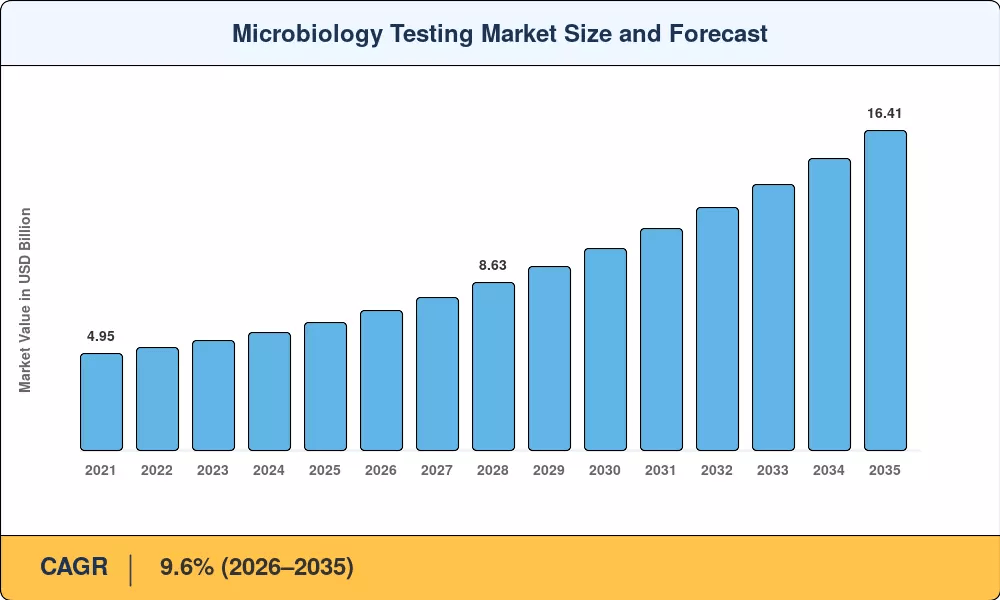
Microbiology Testing Market Size
Microbiology Testing Market to Surge from $ 7.18B in 2026 to $ 16.41B by 2035-By Antimicrobial Resistance Surveillance Mandates, Laboratory Automation Adoption
NY, CA, UNITED STATES, June 23, 2026 /EINPresswire.com/ -- As per Market Research Future, the global Microbiology Testing Market size is projected to reach USD 16.41 Billion by 2035 from USD 7.18 Billion in 2026, at a CAGR of 9.6% during the forecast period 2026–2035. The market base was estimated at USD 6.55 Billion in 2025.The 9.6% CAGR—anchored by structural diagnostic demand rather than discretionary healthcare spending—is driven by three converging forces: rising global antimicrobial resistance (AMR) surveillance mandates that continue to widen the addressable base, sustained laboratory automation adoption that has pulled mid-tier and high-complexity laboratories into multi-year upgrade cycles, and the technological shift from legacy culture-based workflows toward AI-enabled mass-spectrometry platforms and syndromic molecular panels that deliver actionable results within two to four hours.
National governments and multilateral health organizations are amplifying this momentum. The World Health Organization reports that drug-resistant illnesses killed 1.27 million people in 2019 and may lead to 10 million deaths annually by 2050 if unchecked. Governments across G7 and G20 nations have committed approximately USD 4.8 billion in AMR surveillance and stewardship financing between 2023 and 2025, directly feeding demand for advanced testing infrastructure.
Request A Free Sample:
https://www.marketresearchfuture.com/sample_request/697
Key Market Trends & Growth Drivers
Rising Antimicrobial Resistance Burden and Surveillance Mandates
According to the WHO's Global Action Plan on Antimicrobial Resistance, drug-resistant illnesses killed 1.27 million people in 2019 and might lead to 10 million deaths annually by 2050 if no action is taken. Governments across G7 and G20 nations have responded to this existential public health concern by committing approximately USD 4.8 billion in AMR surveillance and stewardship financing between 2023 and 2025. Clinical laboratories are being mandated to report susceptibility data to national surveillance registries, driving the volume and frequency of microbiological testing. Each percentage point of surveillance coverage gain translates into measurable procurement volume, and the AMR testing schedule embedded in routine clinical and pharmaceutical quality control makes this driver structurally durable through 2035.
Laboratory Automation and Workforce Shortage Mitigation
Total laboratory automation platforms—combining pre-analytical track systems, automated incubation, and digital colony counting—reduce manual handling by up to 70%, enabling a single technologist to manage workloads that previously required three.
Capital expenditure on these platforms crossed USD 1.2 Billion in 2024, and procurement pipelines suggest a doubling by 2030. This workforce dynamic is a structural tailwind for the Microbiology Testing Market over the medium term, as a double-digit technologist vacancy rate afflicts clinical labs across North America and Europe.
Syndromic Molecular Panel Adoption and Rapid Pathogen Identification
Multiplex PCR panels that simultaneously detect 20+ respiratory, gastrointestinal, or bloodstream pathogens within one to two hours have moved from emergency use to routine clinical practice. Hospital systems report a 35% reduction in time-to-targeted-therapy and a 22% decrease in unnecessary broad-spectrum antibiotic prescriptions after deploying these panels.
Panel manufacturers are extending menus to cover transplant-related and tropical pathogens, broadening their relevance in the Microbiology Testing Market. In September 2024, bioMérieux rolled out its BIOFIRE SPOTFIRE Respiratory/Sore Throat (R/ST) Panel Mini, a specialized point-of-care multiplex PCR test that identifies 5 common viral and bacterial causes of respiratory tract infections in roughly 15 minutes under a CLIA-waived workflow, signaling the manufacturer's belief that rapid molecular methods will increase the reach of both hospital and community-based testing.
Ask for Customization:
https://www.marketresearchfuture.com/ask_for_customize/697
Market Segment Insights
BY PRODUCT
Reagents & Consumables: Dominant segment in 2025, driven by recurring procurement cycles across all end users. bioMérieux, BD, and Thermo Fisher anchor this segment with proprietary cartridge and media portfolios.
Instruments & Equipment: Fastest-growing product category at 12.6% CAGR (2026–2035). Laboratories are upgrading to automated platforms that offer digital image-based colony reading, MALDI-TOF identification, and total laboratory automation lines.
BY TECHNOLOGY
Culture-Based Testing: Dominant technology with 49.4% revenue share in 2025. Remains the regulatory gold standard for confirmatory testing, against which newer technologies are validated.
Molecular Diagnostics: Fastest-growing technology class at 13.2% CAGR (2026–2035). Multiplex PCR and syndromic panels detect 20+ targets from a single specimen in under two hours, dramatically improving time-to-treatment in critical-care settings.
BY APPLICATION
Clinical Diagnostics: Dominant application with 33.4% revenue share in 2025. Driven by hospital sepsis protocols, respiratory panel adoption, and blood-culture surveillance across acute-care hospitals and reference laboratories.
Pharmaceutical & Biotechnology QC: Growing at 9.8% CAGR. EU Annex 1 and FDA cGMP mandates for environmental monitoring, sterility testing, and bioburden release are converting voluntary rapid-method adoption into mandatory compliance.
BY END USER
Hospitals & Diagnostic Laboratories: Largest segment at ~56.1% share in 2025. National hospital procurement through ministries of health and GPO tenders dominates volume, channeling routine and high-complexity microbiology supply.
Pharmaceutical & Biotech Companies: USD 1.15 Billion in 2025, serving as the physical point of regulatory QC compliance, sterility testing, and environmental monitoring in manufacturing settings.
Read Detailed Insights:
https://www.marketresearchfuture.com/reports/microbiology-testing-market-697
Regional Outlook
North America — Dominant Market (~45.1% Share, 2025)
The United States generates approximately 78% of North American Microbiology Testing Market revenue, driven by over 260,000 CLIA-certified laboratories and strong institutional demand from the VA Health System and large integrated delivery networks (IDNs).
CMS reimbursement reform and VA hospital upgrades support premium-priced molecular panel and automation demand that pooled-procurement regions cannot match. The 2024 investment in total laboratory automation exceeded USD 1.2 billion globally, with North America capturing the majority share.
Europe — Second Largest (~26.5% Share, 2025)
Europe's Microbiology Testing Market reflects divergent national strategies under a harmonizing regulatory umbrella. Germany anchors regional demand with ~23% share, driven by DIN/ISO pharma QC standards and the Charité network's research infrastructure.
The UK's NHS Long Term Plan earmarked GBP 500 Million for diagnostic transformation, including point-of-care and rapid molecular microbiology platforms, growing at 9.4% CAGR. France contributes USD 0.27 Billion through ANSM rapid-method mandates.
Asia-Pacific — Fastest-Growing Region (11.2% CAGR, 2026–2035)
Asia-Pacific is the engine of the Microbiology Testing Market. China holds the largest regional share at ~36%, with Healthy China 2030 allocating over USD 3 billion toward infectious-disease laboratory infrastructure since 2021. India is growing at 12.8% CAGR on the back of NABL accreditation expansion, bringing quality-certified microbiology services to Tier-2 and Tier-3 cities, and on TB diagnostics demand.
Japan contributes USD 0.19 Billion through PMDA fast-track pathways for rapid diagnostics. South Korea is growing at 10.5% CAGR on K-BioHealth Strategy investments. ASEAN economies hold ~11% of regional share on WHO Essential Diagnostics procurement. The rest of Asia-Pacific is growing at 10.2% CAGR on donor-supported laboratory strengthening. The region's combined contribution anchors the global volume base for infectious-disease and AMR surveillance demand.
Middle East & Africa — Emerging Opportunity (USD 0.29 Billion, 2025)
The Middle East & Africa carries the widest infrastructure gap and therefore significant opportunity. Saudi Arabia leads the region with ~28% share, with Vision 2030 healthcare city projects deploying fully automated microbiology lines across 15 new hospital complexes. The UAE is growing at 10.8% CAGR on Dubai Health Authority lab accreditation and medical tourism infrastructure.
South America — Growing Presence (USD 0.34 Billion, 2025)
Brazil anchors South America's Microbiology Testing Market at ~54% of regional revenue, with ANVISA's progressive alignment with ICH pharmaceutical quality standards providing a stable demand floor that smooths regional forecasts. Argentina is growing at 8.6% CAGR on ANMAT lab-upgrade mandates and expedited registration pathways for rapid microbial methods.
Competitive Landscape and Recent Developments
The Microbiology Testing Market exhibits medium concentration, with an estimated Herfindahl-Hirschman Index in the moderately concentrated range and the top five companies controlling an estimated 48–55% of global revenue. Concentration is highest in high-income segments where regulatory and manufacturing barriers are steep; the pooled-procurement tier is more fragmented as regional producers compete on price.
The competitive landscape is stratified between full-spectrum diagnostics leaders serving clinical and pharmaceutical markets, molecular platform specialists capturing syndromic panel growth, and niche players dominating food-safety and environmental monitoring segments.
KEY COMPANIES AND RECENT MILESTONES
bioMérieux (September 2024): Rolled out its BIOFIRE SPOTFIRE Respiratory/Sore Throat (R/ST) Panel Mini, a specialized point-of-care multiplex PCR test identifying 5 common viral and bacterial causes of respiratory tract infections in roughly 15 minutes under a CLIA-waived workflow. Estimated revenue share: ~12–16%.
Becton, Dickinson (BD) (2024–2025): Maintains leadership with BD BACTEC, BD Phoenix, and BD Kiestra integrated pre-analytics-to-identification workflows, commanding ~10–13% of global Microbiology Testing Market revenue. Premium automation positioning in high-complexity laboratories offsets tender-price compression in pooled procurement.
Danaher (Beckman Coulter / Cepheid) (May 2023): Received FDA clearance for the Xpert Xpress MVP multiplex panel detecting vaginitis-related pathogens, broadening the GeneXpert molecular menu. Estimated revenue share: ~8–11%.
Future Outlook: 2026–2035
By 2030, AI-augmented diagnostic decision support will become the operating system of microbiology laboratory delivery. An estimated 40% of high-complexity microbiology laboratories in OECD countries will deploy AI-augmented colony morphology readers and susceptibility prediction engines, learning from isolated institutional libraries to flag unusual resistance patterns before conventional phenotypic results are available.
Cloud platforms that aggregate anonymized susceptibility patterns can provide pharmaceutical corporations, public-health agencies, and insurers with resistance heatmaps in real-time on a subscription basis, creating a data-as-a-service layer that adds to existing instrument and reagent revenue streams.
Decentralized and near-patient testing models will reframe cost structures by the early 2030s. Advances in microfluidic cartridge technology and isothermal amplification are moving microbiology testing closer to the patient's bedside, emergency department, and outpatient clinic. The IVD industry's investment in CLIA-waived and CE-marked point-of-care microbiology platforms exceeded USD 700 million in 2024. As per-test costs fall with scale, the addressable channel widens from centralized reference laboratories to district hospitals, pharmacies, and community health workers, extending microbiology testing beyond traditional settings.
More Related Research Insights:
https://www.marketresearchfuture.com/reports/infectious-disease-diagnosis-treatment-market-7031
https://www.marketresearchfuture.com/reports/molecular-diagnostics-market-1171
https://www.marketresearchfuture.com/reports/clinical-laboratory-services-market-7145
https://www.marketresearchfuture.com/reports/in-vitro-diagnostics-market-1165
https://www.marketresearchfuture.com/reports/microbiology-testing-market-697
https://www.marketresearchfuture.com/reports/polymerase-chain-reaction-market-19212
https://www.marketresearchfuture.com/reports/immunoassay-market-5841
https://www.marketresearchfuture.com/reports/point-of-care-diagnostics-testing-market-10642
https://www.marketresearchfuture.com/reports/antibiotic-susceptibility-testing-market-26881
Larry Wilson
WantStats Research And Media Pvt. Ltd.
+1 855-661-4441
email us here
Visit us on social media:
LinkedIn
Facebook
YouTube
X
Legal Disclaimer:
EIN Presswire provides this news content "as is" without warranty of any kind. We do not accept any responsibility or liability for the accuracy, content, images, videos, licenses, completeness, legality, or reliability of the information contained in this article. If you have any complaints or copyright issues related to this article, kindly contact the author above.
