

Biological Skin Substitutes Market to reach USD 1,001.04 Million by 2035 at 9.6% CAGR
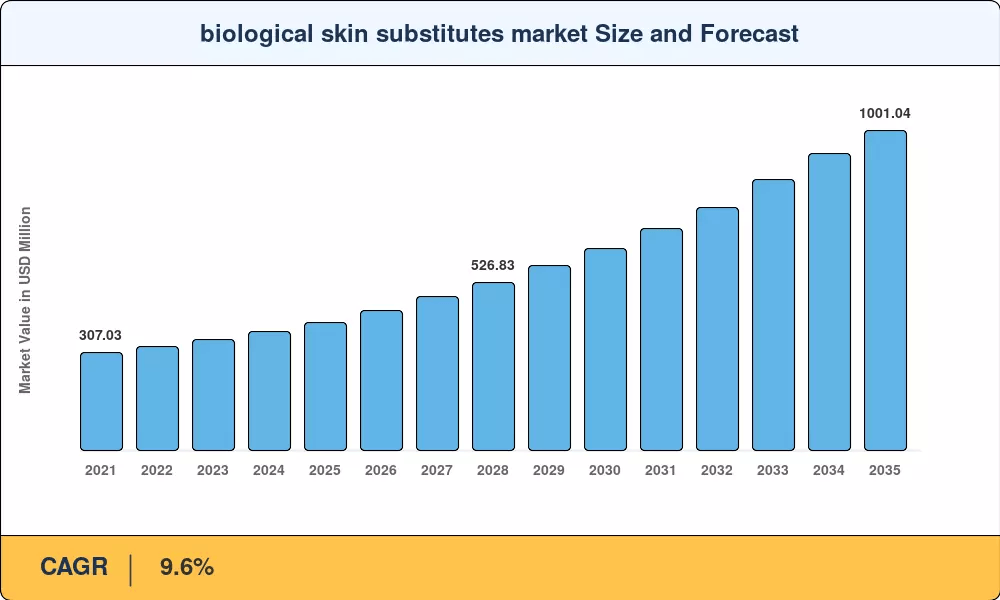
Biological Skin Substitutes Market Size
Biological Skin Substitutes Market to Surge from USD 438.58 Mn in 2026 to USD 1,001.04 Mn by 2035-By CMS Reimbursement Expansion for Cellular Based Products
NY, CA, UNITED STATES, June 18, 2026 /EINPresswire.com/ -- As per Market Research Future, the global Biological Skin Substitutes Market size to reach USD 1,001.04 Million by 2035 from USD 438.58 Million in 2026, at a CAGR of 9.6% during the forecast period 2026--2035. The market base was estimated at USD 400.16 Million in 2025.The 9.6% CAGR---anchored by structural wound care demand rather than discretionary healthcare spending---is driven by three converging forces: CMS reimbursement expansion for cellular/tissue-based products that continue to widen the addressable base for bioengineered wound dressings, sustained military R&D migration to civilian burn care that has pulled regenerative skin products from battlefield protocols into VA hospital networks, and 3-D bioprinting manufacturing scale-up that has converted acellular skin matrices from artisanal tissue-bank products into reproducible, batch-consistent regenerative skin products.
National governments and multilateral health organizations are amplifying this momentum. CMS maintains over 20 active Local Coverage Determinations covering dermal tissue substitutes and bioengineered wound dressings, with eight new LCDs finalized in July 2024 adding acellular skin matrices to Medicare coverage across three MAC jurisdictions. The U.S. Department of Defense's Armed Forces Institute of Regenerative Medicine allocated over USD 85 Million in fiscal-year 2024 for battlefield wound-closure research that routinely transitions into civilian burn units.
The International Diabetes Federation projects 783 million adults living with diabetes by 2045, with diabetic foot ulcers affecting roughly 19--34% of that population at least once. Wake Forest Institute for Regenerative Medicine reported a 40% throughput gain in its bioprinted dermal tissue substitutes pilot line during 2024. Together, these initiatives are creating the procurement infrastructure and delivery innovation on which the Biological Skin Substitutes Market depends.
Request A Free Sample:
https://www.marketresearchfuture.com/sample_request/11633
Key Market Trends & Growth Drivers
CMS Reimbursement Expansion for Cellular/Tissue-Based Products
CMS and its Medicare Administrative Contractors proposed substantial modifications to coverage for cellular/tissue-based products and skin substitution grafts in late 2025. However, prior to their planned implementation on January 1, 2026, these policies were dropped in December 2025. Rather, CMS established a national flat charge of USD 127.14 per square centimeter as part of a new, unified payment mechanism for non-BLA items. Medicare Part B spending on these goods had increased dramatically since 2019, and this action was intended to slow that development. While CMS continues to assess future evidence-based standards, coverage criteria are still primarily guided by Legacy Policies in place.
U.S. payers are piloting episode-based payment bundles that reward faster time-to-closure, creating direct economic incentives for bioengineered wound dressings with superior healing data. Manufacturers that build health-economics dossiers alongside clinical trials will capture formulary positions ahead of competitors relying solely on product-feature marketing.
Early-adopter health systems report that CMS Local Coverage Determinations that tie payment to documented wound-closure timelines drive the strongest adoption shifts. Evidence-gated reimbursement favors data-rich manufacturers. The shift toward value-based wound-care contracting is gradually decentralizing regenerative skin products from inpatient burn units to outpatient wound centers and ambulatory surgical centers.
Military R&D Migration to Civilian Burn Care
The Department of Defense's Congressionally Directed Medical Research Programs, including the Reconstructive Transplant Research Program, are principally responsible for overseeing the U.S. military's support for regenerative medicine. Recent initiatives include a multi-year, multi-million dollar research focus on advanced tissue engineering for burn and difficult wound repair, involving large networks such as the Armed Forces Institute of Regenerative Medicine.
These collaborations continuously spur innovation from basic research to civilian clinical acceptance. The DoD's sustained investment in skin graft alternatives ensures a steady pipeline of clinically validated products transitioning into VA hospital networks.
Pooled procurement through Veterans Affairs group purchasing organizations drives per-unit prices down for high-volume dermal tissue substitutes, expanding access while compressing manufacturer margins. Military procurement prioritizes field-deployable products with ambient storage and rapid application. These contracts often catalyze commercial launches within five to seven years.
MiMedx Group secured a five-year, USD 42 Million Veterans Affairs contract for EpiFix amniotic-tissue allografts in November 2024---the agency's largest single skin graft alternatives procurement to date. In the US, military-to-civilian technology transfer is accelerating as VA hospitals adopt regenerative skin products validated under combat-casualty protocols.
3-D Bioprinting Manufacturing Scale-Up
Legacy cadaveric allografts and simple xenografts are yielding shelf space to bioengineered wound dressings built on 3-D bioprinting platforms and autologous cell-harvesting cartridges. Wake Forest Institute for Regenerative Medicine reported a 40% throughput gain in its bioprinted dermal tissue substitutes pilot line during 2024, printing multi-layered dermal constructs in under 45 minutes per 100 cm² sheet.
As bioprinting hardware costs decline---capital expenditure per unit fell approximately 22% between 2022 and 2024---commercial-scale production of bioengineered wound dressings becomes increasingly viable for mid-tier hospital systems. Regulatory bodies in both the United States and the European Union now maintain expedited evaluation pathways for acellular skin matrices that demonstrate faster re-epithelialization versus standard-of-care grafts.
Spray-on autologous cell-harvesting devices---such as next-generation ReCell-class platforms---enable bedside preparation of skin graft alternatives from small biopsies, eliminating donor-site morbidity and cold-chain dependency. Hospitals in resource-limited settings stand to benefit most, as these systems compress the regenerative skin products supply chain to a single procedural step.
The 3-D printed skin category, while nascent, is expanding rapidly as bioengineered wound dressings produced on automated platforms demonstrate batch-to-batch consistency that hand-processed allografts cannot match. Automated bioprinting platforms reduce batch variability and scale output for high-volume centers. Cost parity with traditional allografts is projected around 2031--2033.
Ask for Customization:
https://www.marketresearchfuture.com/ask_for_customize/11633
Market Segment Insights
BY SOURCE MATERIAL
Human Allografts: Dominant segment with ~45.9% revenue share in 2024. Reflecting decades of clinical familiarity and robust tissue-bank infrastructure. Organ-procurement network expansions sustain supply chain reliability. Human donor tissue-derived products benefit from established reimbursement pathways and deep clinical evidence, making them the default choice for burn centers and wound clinics.
Cell-based Constructs: Fastest-growing source material segment at 14.5% CAGR (2026--2035). Powered by autologous keratinocyte spray systems. Autologous cell-harvesting platforms eliminate donor-site morbidity and appeal to military burn protocols, where field-deployable skin graft alternatives reduce evacuation burden. These systems compress the regenerative skin products supply chain to a single procedural step.
Xenografts: USD 118.25 Million in 2025. Omega-3 fish-skin clinical evidence---pioneered by Kerecis---has generated compelling randomized-controlled-trial data for diabetic foot ulcers, positioning this sub-segment as a credible premium alternative to commodity dermal tissue substitutes.
BY PRODUCT TYPE
Acellular Skin Matrices: Dominant segment with ~44.6% revenue share in 2024. Reflecting strong wound-center adoption. Room-temperature storage and long shelf life simplify wound-center inventory management, making acellular skin matrices the preferred choice for outpatient facilities and ambulatory surgical centers.
3-D Printed Skin: Fastest-growing product type at 19.7% CAGR (2026--2035). Manufacturing scalability breakthroughs drive demand. Bioengineered wound dressings produced on automated platforms demonstrate batch-to-batch consistency that hand-processed allografts cannot match. Wake Forest's Integrated Tissue and Organ Printing platform achieved a 40% throughput increase in 2024.
BY APPLICATION
Burns: Dominant application with ~43.2% revenue share in 2024. Underpinned by national burn-center referral networks. Burns continue to anchor application-level demand, with military conflicts and industrial burn incidence maintaining baseline demand for skin graft alternatives across trauma centers worldwide.
Pediatric Congenital Defects: Fastest-growing application segment at 16.8% CAGR (2026--2035). Unmet need in neonatal skin coverage drives premium pricing and accelerated regulatory review timelines for regenerative skin products designed for pediatric use.
Chronic Ulcers: USD 119.45 Million in 2025. Diabetic-ulcer epidemiology growth drives demand. The International Diabetes Federation projects 783 million adults living with diabetes by 2045, with diabetic foot ulcers affecting roughly 19--34% of that population at least once. Each chronic ulcer episode represents a potential use case for acellular skin matrices or cellularized constructs.
BY END USER
Hospitals: Largest segment with ~59.2% share in 2024. Inpatient burn-unit protocols and complex wound management dominate volume, channeling routine regenerative skin products supply. Hospitals retain the largest share, leveraging surgical suites, anesthesia capabilities, and specialist staff to deliver complex skin graft alternative protocols.
Military & Defense: Fastest-growing end-user segment at 15.9% CAGR (2026--2035). Battlefield wound-closure mandates drive dedicated procurement budgets for dermal tissue substitutes validated under combat-casualty protocols. The DoD's sustained investment ensures a steady pipeline of clinically validated products transitioning into civilian care.
Read Detailed Insights:
https://www.marketresearchfuture.com/reports/biological-skin-substitutes-market-11633
Regional Outlook
North America -- Dominant Market (~43.1% Share, 2024)
The United States generates approximately 81.3% of North American Biological Skin Substitutes Market revenue, driven by CMS LCD coverage expansion, mature reimbursement frameworks, and high burn-center density---a single policy ecosystem that converted a palliative-care-dominated market into one with a structural regenerative skin products tail. The US dominates through a combination of over 20 active LCDs covering dermal tissue substitutes, the world's highest per-capita wound-care expenditure, and rapid adoption of novel bioengineered wound dressings. The DoD's sustained investment in skin graft alternatives ensures a steady pipeline of clinically validated products transitioning into VA hospital networks.
Canada contributes through provincial wound-care formulary updates at 10.9% of regional share, while Mexico is growing at steady pace on IMSS burn-center modernization program at USD 13.45 Million in 2025. North America's leadership rests on reimbursement depth and the structural regenerative medicine segment created by expanded CMS compliance mandates and military R&D spillover.
Europe -- Second Largest (~26.4% Share, 2024)
Europe's Biological Skin Substitutes Market reflects divergent national strategies---Germany leads regionally with DRG reimbursement for ATMP products, contributing ~24.8% of regional share, while the UK historically used selective regenerative medicine targeting before broadening coverage through NHS wound-care pathway standardization at 19.6% of regional share. France contributes ~16.2% of regional share through HAS clinical-evidence mandate. Italy is growing at 9.4% CAGR on burn-unit network modernization. Spain contributes USD 6.78 Million on public-hospital procurement expansion.
Harmonization pressure from the EMA's consolidated Advanced Therapy Medicinal Products framework is gradually narrowing these differences, lifting baseline demand across the region while streamlining cross-border market authorization for regenerative skin products. The Nordic countries hold ~8.7% of regional share on centralized Scandinavian purchasing cooperatives. Russia is growing at 7.1% CAGR on domestic manufacturing incentives. Germany and the UK together represent over 44% of regional revenue, with national DRG systems increasingly linking reimbursement to documented wound-closure timelines.
Asia-Pacific -- Fastest-Growing Region (13.4% CAGR, 2026--2035)
Asia-Pacific is the engine of the Biological Skin Substitutes Market. China holds the largest regional share with ~31.7% of regional revenue, driven by national burn-center expansion under Healthy China 2030. India is growing at 15.3% CAGR on the back of Ayushman Bharat coverage of tertiary burn care for over 500 million beneficiaries, yet fewer than 30% of district hospitals stock any biological skin substitute. Japan contributes ~22.4% of regional share through PMDA fast-track for regenerative products at steady pace. South Korea contributes USD 5.92 Million on MFDS conditional approval pathways.
Middle East & Africa -- Emerging Opportunity (10.8% CAGR, 2026--2035)
The Middle East & Africa carries the widest infrastructure gap and therefore the steepest opportunity. Saudi Arabia leads the region with Vision 2030 healthcare investment, contributing ~28.4% of regional share---NEOM health cluster and new specialist hospitals channel capital toward regenerative skin products and advanced dermal tissue substitutes. The UAE contributes USD 3.18 Million on medical-tourism wound-care hubs. South Africa holds ~22.7% of regional share on national burn-registry data program.
South America -- Growing Presence (USD 23.61 Million, 2025)
Brazil anchors South America's Biological Skin Substitutes Market at ~58.3% of regional revenue, with the Unified Health System (SUS) tenders increasingly specifying bioengineered wound dressings for major burn centers, raising product-quality thresholds across the sub-continent and providing a stable demand floor that smooths regional forecasts. Argentina is growing at 7.4% CAGR on provincial burn-center funding.
Competitive Landscape and Recent Developments
The Biological Skin Substitutes Market exhibits medium concentration, with the top five players capturing an estimated 42--48% of global revenue. The Herfindahl-Hirschman Index sits in the 900--1,200 range, reflecting a competitive field where niche innovators coexist with diversified medical-device conglomerates. Patent portfolios around acellular skin matrices and cell-delivery scaffolds shape differentiation, while reimbursement-evidence strength determines formulary access.
The competitive landscape is stratified between broad reimbursed portfolio leaders serving global wound-care markets, cross-selling ecosystem providers capturing advanced wound-management tenders, and fish-skin xenograft innovators consolidating the omega-3 clinical differentiation segment.
KEY COMPANIES AND RECENT MILESTONES
Organogenesis Holdings (March 2025): Received FDA clearance for a next-generation bioengineered wound dressing targeting full-thickness diabetic foot ulcers, expanding its reimbursed product line to 12 SKUs. Broadest reimbursed skin graft alternatives portfolio anchors a strong North America franchise, commanding ~12--15% of global Biological Skin Substitutes Market revenue.
Smith & Nephew (February 2024): Acquired a Berlin-based regenerative skin products startup specializing in growth-factor-loaded hydrogel scaffolds for approximately USD 68 Million. OASIS Matrix and PICO system cross-selling via an advanced wound-management ecosystem anchors a strong global franchise, holding ~8--11% of global revenue.
Future Outlook: 2026--2035
By 2030, personalized bioprinted constructs and AI-augmented wound assessment will become the operating system of advanced wound care. Patient-specific 3-D bioprinted dermal tissue substitutes, seeded with autologous fibroblasts and growth factors, may reach commercial viability by 2030--2032. These bespoke constructs promise near-zero immunogenic rejection and could displace conventional bioengineered wound dressings for complex reconstructive cases. Machine-learning algorithms trained on wound-bed imaging datasets are reaching clinical-grade sensitivity (>92% accuracy) in classifying wound readiness for biological skin substitute application. Integration of these tools into electronic health records will standardize treatment protocols and accelerate appropriate utilization of acellular skin matrices across hospital and outpatient settings.
Platform-based procurement and data-driven outcome platforms will reframe cost structures by the early 2030s. Group-purchasing organizations are consolidating the Biological Skin Substitutes Market spending under outcomes-linked contracts that guarantee minimum healing rates. Manufacturers unable to supply real-world evidence dashboards risk exclusion from these platforms, concentrating future revenue among data-enabled suppliers of regenerative skin products. Real-world evidence registries that link product identifiers to wound-closure outcomes create monetizable data assets for manufacturers seeking premium pricing and expanded coverage designations. Platforms that integrate electronic health record wound-imaging with AI-driven healing prediction strengthen the case for regenerative skin products in formulary reviews.
More Related Research Insights:
https://www.marketresearchfuture.com/reports/tissue-engineering-market-2134
https://www.marketresearchfuture.com/reports/dermal-regeneration-market-24303
https://www.marketresearchfuture.com/reports/skin-graft-market-1674
https://www.marketresearchfuture.com/reports/wound-care-biologics-market-6563
https://www.marketresearchfuture.com/reports/advanced-wound-care-management-market-42063
https://www.marketresearchfuture.com/reports/burn-gel-burn-dressing-market-59932
https://www.marketresearchfuture.com/reports/regenerative-medicine-market-2220
https://www.marketresearchfuture.com/reports/biomaterial-market-2021
Larry Wilson
WantStats Research And Media Pvt. Ltd.
+1 855-661-4441
email us here
Visit us on social media:
LinkedIn
Facebook
YouTube
X
Legal Disclaimer:
EIN Presswire provides this news content "as is" without warranty of any kind. We do not accept any responsibility or liability for the accuracy, content, images, videos, licenses, completeness, legality, or reliability of the information contained in this article. If you have any complaints or copyright issues related to this article, kindly contact the author above.
