

Automotive IoT Market Forecast: USD 1,128.68 Billion Opportunity by 2035
automotive IoT market
Automotive IoT Market Size, Share and Research Report By Component (Hardware, Software, Services), By Connectivity Form (Embedded, Tethered, Integrated),
Automotive IoT Market is enabling connected vehicles through real-time data exchange, predictive maintenance, enhanced safety features, and smart mobility solutions.”
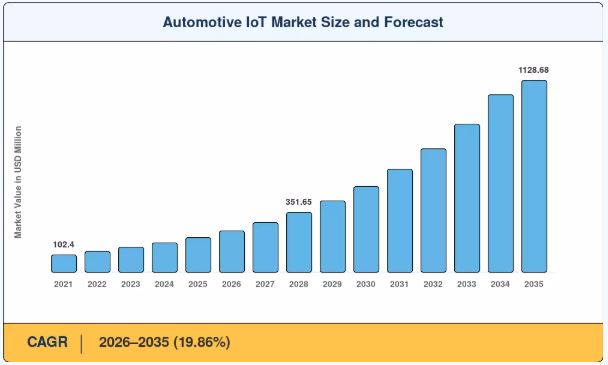
BERLIN, BERLIN, GERMANY, June 19, 2026 /EINPresswire.com/ -- The Global automotive IoT market reached an estimated USD 204.26 billion in 2025 and is projected to grow from USD 244.79 billion in 2026 to USD 1,128.68 billion by 2035, registering a CAGR of 19.86% during the forecast period. — Market Research Future (MRFR)
Two major catalysts are accelerating this trajectory the global regulatory push toward mandatory vehicle-to-everything (V2X) communication infrastructure as part of smart city and intelligent transportation system (ITS) frameworks, and the explosive consumer demand for connected in-vehicle experiences spanning over-the-air (OTA) software updates, real-time telematics, and AI-powered driver assistance systems. With over 1.4 billion connected vehicles expected on global roads by 2035, automakers, Tier-1 suppliers, and mobility service providers face mounting pressure to embed IoT capabilities at every layer of the vehicle architecture or risk competitive obsolescence.
Legacy ECU-based architectures many built on fragmented, point-to-point wiring harnesses designed before cloud connectivity was a design requirement are rapidly giving way to centralized vehicle compute platforms that integrate cellular V2X (C-V2X) modems, embedded SIMs (eSIM), edge AI processors, and cloud-native fleet management software.
A recent McKinsey Center for Future Mobility study estimated that top-quartile OEMs deploying end-to-end IoT connectivity stacks alongside predictive vehicle health monitoring reduced warranty claim costs by 19–24% compared with peers still dependent on dealer-initiated diagnostics. This technology shift is not incremental it represents a fundamental re-architecture of how vehicles are designed, manufactured, sold, and serviced throughout their operational lifespans.
Get Full PDF Sample Copy of Report: (Including Full TOC, List of Tables & Figures, Chart) @
https://www.marketresearchfuture.com/sample_request/29979
✿ How Significant Is the Automotive IoT Market’s Growth?
The automotive IoT market has demonstrated exceptional and sustained expansion, rising from approximately USD 53.7 billion in 2021 to an estimated USD 204.26 billion in 2025, representing a near-doubling of market value in just four years. The market is forecast to nearly quadruple over the next decade, driven by converging megatrends including autonomous vehicle development, electrification, shared mobility, and the broader digitalization of automotive supply chains and aftersales ecosystems.
Rising consumer expectations for seamless digital experiences mirroring the smartphone ecosystem alongside stringent government mandates for eCall emergency systems, emissions telematics, and fleet tracking compliance have created acute demand for embedded IoT hardware and cloud-connected automotive platforms. OEMs, fleet operators, insurance providers, and road authorities are all investing aggressively in connected vehicle infrastructure to unlock new revenue streams, reduce operational costs, and meet evolving safety and sustainability mandates.
✿ What Does the Future Hold for the Automotive IoT Market?
Software-defined vehicles (SDVs) and AI-native connectivity platforms stand at the forefront of the market’s next growth phase. Automotive IoT is transforming vehicles from hardware-centric products into continuously updated, data-generating mobility platforms. Advanced IoT architectures now enable OEMs to deploy OTA feature activations, subscription-based capability unlocking, and real-time behavioral data monetization fundamentally shifting industry revenue models from one-time vehicle sales toward recurring software and data service revenues.
The growing maturity of 5G-V2X ecosystems is another defining force shaping the market’s future. Ultra-low-latency 5G connectivity enables vehicles to communicate with infrastructure, other vehicles, pedestrians, and cloud platforms in near-real-time laying the technical groundwork for Level 4 and Level 5 autonomous driving deployment in geofenced urban corridors. Standards bodies including 3GPP, SAE International, and ETSI are actively finalizing the interoperability frameworks that will govern large-scale V2X deployment through 2035.
Cybersecurity has emerged as a critical investment frontier alongside connectivity expansion. As vehicles become increasingly networked, the attack surface for cyber threats expands proportionally. UN Regulation No. 155 (UN-R155), now mandatory for new vehicle type approvals in the EU, Japan, and South Korea, is compelling OEMs to embed automotive-grade cybersecurity management systems (CSMS) and security operations centers (SOC) directly into their IoT architectures — creating substantial incremental demand for automotive cybersecurity software and managed services.
✿Who Are the Key Players in the Automotive IoT Market?
The automotive IoT landscape is characterized by a complex ecosystem of vehicle OEMs, semiconductor suppliers, telecom operators, cloud platform providers, and specialized automotive technology vendors. Key participants shaping the competitive dynamics include:
★Robert Bosch GmbH — providing comprehensive automotive IoT hardware, sensor systems, and connected mobility software platforms across the global vehicle supply chain
★Continental AG — delivering integrated telematics control units (TCUs), V2X communication modules, and intelligent transportation system solutions
★Qualcomm Technologies Inc. — supplying Snapdragon Automotive platforms combining cellular connectivity, edge AI processing, and V2X capabilities for next-generation SDVs
★Harman International (Samsung) — offering connected car platforms, OTA lifecycle management, and in-vehicle infotainment systems with deep IoT integration
★Aptiv PLC — developing high-voltage EV architecture systems and advanced vehicle connectivity solutions optimized for software-defined vehicle platforms
★LG Electronics — providing vehicle component solutions spanning in-vehicle infotainment, telematics, and EV powertrain components with embedded connectivity
★Verizon Connect — offering enterprise fleet IoT platforms combining GPS telematics, driver behavior analytics, and predictive maintenance capabilities
★Ericsson — delivering 5G-V2X network infrastructure and automotive-grade cellular connectivity solutions for OEM and smart city deployments
★AWS (Amazon Web Services) — powering cloud-native connected vehicle platforms with IoT Core, analytics, and ML services adopted by leading global automakers
★Microsoft Azure — providing intelligent cloud infrastructure for automotive IoT, OTA management, and digital twin vehicle lifecycle platforms
Competition in the market is intensifying as technology providers race to build end-to-end automotive IoT stacks spanning silicon, connectivity, cloud, and application layers. Strategic acquisitions of automotive software startups, deep OEM co-development programs, and alliances with telecom operators and mapping platform providers are fundamentally reshaping the competitive landscape through 2035.
✿ What Are the Emerging Trends in the Automotive IoT Market?
Several transformational trends are redefining how the automotive IoT market evolves through 2035:
Software-Defined Vehicle (SDV) Architecture: Central vehicle computers replacing distributed ECU networks are enabling OTA updates, feature-on-demand activation, and continuous post-sale monetization — fundamentally restructuring automotive product lifecycles and OEM revenue models.
5G-V2X Ecosystem Maturation: The commercial deployment of 5G Cellular-V2X (C-V2X) networks is enabling real-time vehicle-to-infrastructure, vehicle-to-vehicle, and vehicle-to-pedestrian communication — creating the connectivity backbone for cooperative autonomous driving systems.
Automotive Cybersecurity Integration: UN-R155 and ISO/SAE 21434 compliance requirements are driving OEMs and Tier-1 suppliers to embed CSMS frameworks, intrusion detection systems (IDS), and end-to-end encrypted communication protocols into every connected vehicle platform.
Predictive Maintenance & Vehicle Health IoT: Connected diagnostics platforms leveraging edge AI and cloud analytics are enabling real-time component health monitoring, proactive fault prediction, and automated service scheduling — reducing unplanned breakdowns and warranty cost exposure across OEM and fleet operator segments.
EV Ecosystem IoT Integration: Electric vehicle IoT platforms are expanding beyond basic telematics to encompass smart charging network management, battery state-of-health monitoring, energy grid demand response, and V2G (vehicle-to-grid) bidirectional energy management capabilities.
Usage-Based Insurance (UBI) & Mobility Data Monetization: Telematics-generated behavioral driving data is enabling insurance carriers to deploy pay-as-you-drive (PAYD) and pay-how-you-drive (PHYD) models, while OEMs explore direct data monetization with mapping, retail, and smart city platform partners.
Get access to the full description of the report @
https://www.marketresearchfuture.com/reports/automotive-iot-market-29979
✿ How Is the Automotive IoT Market Segmented?
The automotive IoT market report provides a comprehensive segmentation framework:
By Connectivity Technology: Embedded (3G/4G/5G), Tethered, Integrated; V2X (C-V2X, DSRC)
By Application: Telematics & Fleet Management, Infotainment & Navigation, ADAS & Autonomous Driving, Remote Diagnostics, EV Charging Management, Usage-Based Insurance
By Vehicle Type: Passenger Cars, Light Commercial Vehicles (LCV), Heavy Commercial Vehicles (HCV), Electric Vehicles (EV)
By Component: Hardware (TCUs, Sensors, Gateways), Software Platforms, Connectivity Services
By End-User: OEMs, Fleet Operators, Aftermarket Service Providers, Insurance Companies, Road Authorities
✿ What Are the Regional Insights from the Automotive IoT Market?
North America commands approximately 32% of global automotive IoT market share, underpinned by the region’s leading autonomous vehicle testing ecosystem, high smartphone and 5G penetration rates, and a mature OEM and Tier-1 supplier base investing heavily in software-defined vehicle platforms. The U.S. National Highway Traffic Safety Administration’s (NHTSA) connected vehicle mandates and V2X pilot programs further reinforce the region’s technology leadership.
Europe holds the second-largest share at approximately 28%, with Germany, France, and Sweden representing the primary automotive IoT investment hubs. The EU’s General Safety Regulation (GSR2) mandating advanced safety systems across all new vehicle categories, combined with the European Green Deal’s EV adoption targets, is compelling OEMs and suppliers to accelerate IoT-enabled electrification and safety technology rollouts across the region.
Asia-Pacific represents the largest and fastest-growing region by volume, anchored by China’s globally dominant connected vehicle production ecosystem. Chinese OEMs including BYD, SAIC, and NIO are deploying some of the world’s most advanced automotive IoT architectures, supported by the government’s aggressive V2X infrastructure buildout and smart city integration programs. Japan and South Korea contribute significant semiconductor and Tier-1 supplier innovation to the global automotive IoT value chain.
Middle East & Africa is projected to register a CAGR of approximately 14.1% through 2035, driven by the UAE’s and Saudi Arabia’s smart city and autonomous mobility ambitions (including the NEOM and Dubai Autonomous Transportation Strategy initiatives), alongside rising vehicle connectivity adoption across South Africa and Nigeria’s growing commercial fleet sector.
South America rounds out the global picture, with Brazil and Mexico representing the most active automotive IoT markets, primarily driven by fleet telematics adoption, stolen vehicle recovery systems, and insurance telematics growth across the region’s rapidly expanding passenger and commercial vehicle base.
➤➤➤ Industry Analysis Reports by Market Research Future:
Oil & Gas Scada Market-
https://www.marketresearchfuture.com/reports/oil-gas-scada-market-7925
Optical Encoder Market-
https://www.marketresearchfuture.com/reports/optical-encoder-market-7932
Payment As A Service Market-
https://www.marketresearchfuture.com/reports/payment-service-market-8020
Converter Modules Market-
https://www.marketresearchfuture.com/reports/converter-modules-market-8164
Smartphone Market-
https://www.marketresearchfuture.com/reports/smartphone-market-8165
Photoelectric Sensor Market-
https://www.marketresearchfuture.com/reports/photoelectric-sensor-market-8168
Vision Processing Unit Market-
https://www.marketresearchfuture.com/reports/vision-processing-unit-market-8177
Household Robot Market-
https://www.marketresearchfuture.com/reports/household-robot-market-8196
Hardware Acceleration Market-
https://www.marketresearchfuture.com/reports/hardware-acceleration-market-8249
Kids Tablet Market-
https://www.marketresearchfuture.com/reports/kids-tablet-market-8338
Sagar Kadam
Market Research Future
+1 628-258-0071
email us here
Legal Disclaimer:
EIN Presswire provides this news content "as is" without warranty of any kind. We do not accept any responsibility or liability for the accuracy, content, images, videos, licenses, completeness, legality, or reliability of the information contained in this article. If you have any complaints or copyright issues related to this article, kindly contact the author above.
