

Surgical Navigation Systems Market to reach USD 33.17 Billion by 2035 at 12.5% CAGR
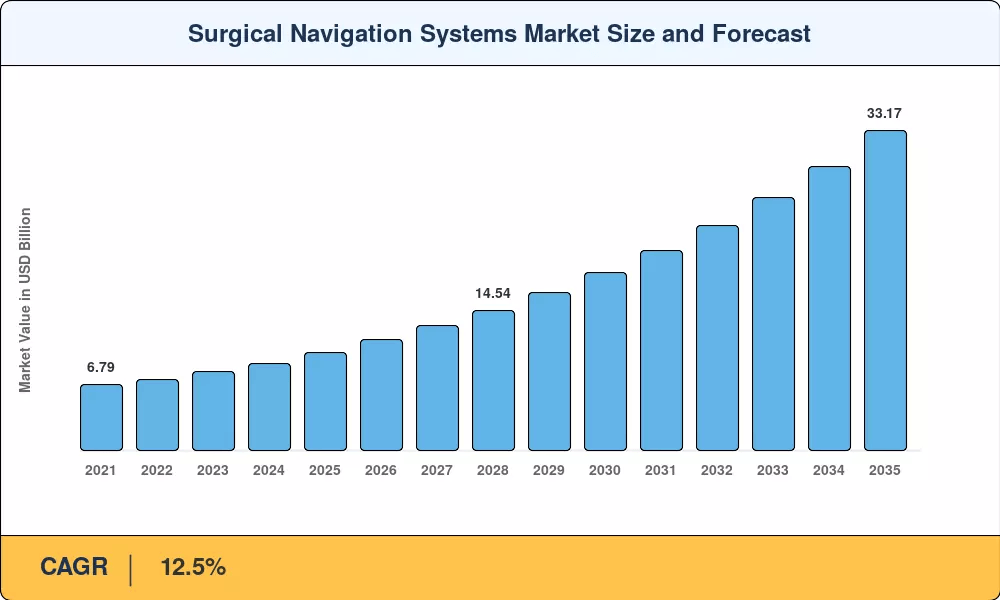
Surgical Navigation Systems Market Size
Surgical Navigation Systems Market to Surge from USD 11.49 Billion in 2026 to USD 33.17 Billion by 2035---Powered by Bundled-Payment Reimbursement Models
NY, CA, UNITED STATES, June 17, 2026 /EINPresswire.com/ -- As per Market Research Future, the global Surgical Navigation Systems Market size to reach USD 33.17 Billion by 2035 from USD 11.49 Billion in 2026, at a CAGR of 12.5% during the forecast period 2026--2035. The market base was estimated at USD 10.12 Billion in 2025.The 12.5% CAGR---anchored by structural surgical demand rather than discretionary healthcare spending---is driven by three converging forces: bundled-payment reimbursement models that reward hospitals for demonstrable outcome improvements and continue to widen the addressable base for intraoperative navigation technology, sustained AI-powered surgical planning integration that has pulled image-guided surgery systems into routine procurement cycles, and the global push toward minimally invasive workflows that slash revision rates by up to 40% in complex spinal and cranial procedures.
National governments and multilateral health organizations are amplifying this momentum. The U.S. Centers for Medicare & Medicaid Services (CMS) BPCI-A program and its successor TEAM model tie reimbursement to 30-day episode outcomes, making navigation platforms a revenue-protection investment rather than a discretionary purchase. Deep-learning algorithms trained on 500,000+ anonymized spinal CT scans can now predict optimal screw trajectories with sub-millimeter accuracy, reducing intraoperative repositioning by 30%. China's 14th Five-Year Plan earmarked RMB 82 billion for tertiary hospital modernization, with 3D surgical navigation tools and intraoperative imaging suites listed as priority capital items. Medtronic, Stryker, and Brainlab collectively channeled over USD 1.8 billion into R&D for 3D surgical navigation tools between 2023 and 2025. Together, these initiatives are creating the procurement infrastructure and delivery innovation on which the Surgical Navigation Systems Market depends.
Request A Free Sample:
https://www.marketresearchfuture.com/sample_request/7863
Key Market Trends & Growth Drivers
Bundled-Payment Reimbursement and Value-Based Care
National reimbursement schedules increasingly tie payment to episode outcomes rather than procedure volume, with CMS BPCI-A participation and its successor TEAM model---effective January 1, 2026---requiring 30-day accountability windows that directly reward hospitals for demonstrable outcome improvements. The financial architecture makes navigation platforms a revenue-protection investment rather than a discretionary purchase. European equivalents---Germany's DRG surcharges for robot-assisted procedures and France's RIHN innovation funding---mirror the incentive, giving the Surgical Navigation Systems Market a dual-continent policy tailwind. Each percentage point of value-based care adoption translates into measurable procurement volume for intraoperative navigation technology, and the image-guided surgery systems embedded in routine surgical workflows make this driver structurally durable through 2035.
Several U.S. malpractice carriers now offer 5--10% premium discounts for practices using leading intraoperative GPS for surgeons platforms, converting navigation adoption from a cost center into a risk-management asset. Early-adopter health systems report that computer-assisted surgical planning platforms feed AI predictions into real-time anatomical tracking dashboards that update at 60 Hz during the procedure, cutting average operative times by 15--22 minutes in peer-reviewed orthopedic trials. A 2024 multicenter trial across 14 European hospitals showed AI-assisted pedicle screw placement achieving 97.2% accuracy versus 91.8% for the freehand technique, translating into measurable reductions in revision surgery costs.
AI-Powered Surgical Planning and Intraoperative Guidance
Legacy fluoroscopy-only setups are giving way to hybrid platforms that merge intraoperative navigation technology with AI-powered planning modules. Deep-learning algorithms trained on 500,000+ anonymized spinal CT scans can now predict optimal screw trajectories with sub-millimeter accuracy, reducing intraoperative repositioning by 30%. Computer-assisted surgical planning platforms from Brainlab and Stryker feed these predictions into real-time anatomical tracking dashboards that update at 60 Hz during the procedure. A 2024 multicenter trial across 14 European hospitals showed AI-assisted pedicle screw placement achieving 97.2% accuracy versus 91.8% for the freehand technique, translating into measurable reductions in revision surgery costs.
Pooled procurement through hospital group purchasing organizations drives per-unit prices down for high-volume 3D surgical navigation tools, expanding access while compressing manufacturer margins. By 2028, an estimated 45% of newly installed robotic-surgical systems globally will include factory-integrated navigation, up from 22% in 2024, accelerating replacement cycles across the Surgical Navigation Systems Market. This convergence compresses capital budgets---one integrated system replaces two---and lowers the training burden on surgical teams. In the US, AI-powered navigation adoption is accelerating as hospitals seek competitive differentiation through precision surgery outcomes.
Minimally Invasive Workflow Expansion and Hybrid OR Buildouts
The global push toward minimally invasive workflows has turned image-guided surgery systems from premium add-ons into operational necessities, slashing revision rates by up to 40% in complex spinal and cranial procedures. China's 14th Five-Year Plan earmarked RMB 82 billion for tertiary hospital modernization, with 3D surgical navigation tools and intraoperative imaging suites listed as priority capital items. India's Ayushman Bharat Digital Mission is connecting 150,000+ health facilities to a unified digital backbone, creating an addressable install base for connected navigation platforms. Japan's PMDA fast-tracked regulatory clearance for seven navigation devices in FY 2024 alone, signaling an environment where intraoperative GPS for surgeons gains institutional backing across the region.
India plans to add 350+ hybrid operating theatres between 2025 and 2030 under the Pradhan Mantri Swasthya Suraksha Yojana (PMSSY) expansion. Brazil's SUS public-health system allocated BRL 4.2 billion for hospital infrastructure upgrades in 2024, with image-guided surgery systems explicitly listed as eligible capital expenditures. These programs shift the Surgical Navigation Systems Market addressable base beyond traditional OECD geographies. The shift toward outpatient and ambulatory surgery is gradually decentralizing navigation deployment from academic medical centers to ASCs and community hospitals, expanding the addressable channel.
Ask for Customization:
https://www.marketresearchfuture.com/ask_for_customize/7863
Market Segment Insights
BY TECHNOLOGY
Electromagnetic Navigation Systems: Dominant segment with ~38.2% revenue share in 2025. Reflecting deep clinical entrenchment in neurosurgery suites. These platforms use low-frequency magnetic fields to track instrument tips in three-dimensional space, delivering sub-millimeter accuracy that satisfies the precision demands of intraoperative GPS for surgeons in cranial and spinal corridors. The absence of line-of-sight requirements makes them ideal for deep-cavity ENT and neurosurgical cases where optical cameras cannot maintain unobstructed views.
Optical Navigation Systems: Fastest-growing technology segment at 7.45% CAGR (2026--2035). Driven by 3D surgical navigation tools that pair with robotic arms. Infrared camera arrays mounted on the robot's boom provide real-time anatomical tracking that updates at refresh rates above 60 Hz. Stryker's Mako and Zimmer Biomet's ROSA platforms both leverage optical tracking for knee and hip arthroplasty, a workflow that resonates with orthopedic surgeons seeking reproducible implant alignment.
BY APPLICATION
Neurosurgery: Dominant application with ~36.4% revenue share in 2025. Driven by the criticality of real-time anatomical tracking in cranial procedures. The sub-millimeter precision of image-guided surgery systems directly correlates with reduced neurological deficit rates, making navigation an evidence-backed standard of care in academic neurosurgery departments worldwide. Tumor resection precision and deep-brain stimulation electrode placement anchor this segment.
ENT Surgery: Fastest-growing application segment at 8.55% CAGR (2026--2035). Fueled by the global rise in functional endoscopic sinus surgery (FESS) volumes and the increasing use of real-time anatomical tracking to avoid critical structures like the optic nerve and internal carotid artery during complex revision cases. Navigation adoption in ENT is accelerating outside tertiary centers as compact, cart-free systems lower the footprint and cost barriers for community-hospital ENT suites.
BY END USER
Hospitals & Academic Medical Centers: Largest segment at ~62.8% share in 2025. Complex case volumes and teaching mandates dominate volume, channeling routine intraoperative navigation technology supply. Teaching institutions also serve as clinical validation sites, generating the peer-reviewed evidence that unlocks reimbursement for 3D surgical navigation tools in new procedural categories.
Ambulatory Surgical Centers: Fastest-growing end-user segment at 9.35% CAGR (2026--2035). Outpatient spine decompression, sinus surgery, and unicompartmental knee arthroplasty shift to lower-cost settings. Compact navigation units priced below USD 200,000 and designed for rapid setup are enabling ASCs to offer image-guided surgery systems without the capital intensity of a full hybrid OR build.
Specialty Clinics & Research Institutes: USD 0.72 Billion in 2025. Clinical-trial device evaluation and specialized procedure volumes drive demand for cutting-edge computer-assisted surgical planning platforms.
BY COMPONENT
Hardware: Dominant component with ~52% revenue share in 2025. Tracking arrays, navigation towers, robotic arms, and imaging interfaces anchor this segment. Capital equipment depreciation cycles of 7--10 years create predictable replacement demand.
Software: Fastest-growing component segment at 13.2% CAGR (2026--2035). AI-powered planning modules, real-time anatomical tracking algorithms, and cloud-based analytics platforms drive recurring subscription revenue. By 2032, recurring software and data-services revenue could account for 30--35% of total market value, up from an estimated 12% in 2025.
Services: USD 1.42 Billion in 2025. Training, technical support, and maintenance contracts generate recurring revenue streams. Each new image-guided surgery system installation requires 40--60 hours of hands-on training per surgical team.
Read Detailed Insights:
https://www.marketresearchfuture.com/reports/surgical-navigation-systems-market-7863
Regional Outlook
North America -- Dominant Market (~35.2% Share, 2025)
The United States generates approximately 78.4% of North American Surgical Navigation Systems Market revenue, driven by CMS bundled-payment incentives and a mature installed base of 3D surgical navigation tools across 1,800+ Level I and II trauma centers---a single policy shift that converted a fluoroscopy-dominated market into one with a structural navigation tail. The US dominates through a combination of value-based care mandates, high hospital IT maturity, and rapid adoption of robotic-navigation convergence platforms. BPCI-A participation and the TEAM successor model tie reimbursement directly to navigation-enabled outcome improvements.
Europe -- Second Largest (~28.5% Share, 2025)
Europe's Surgical Navigation Systems Market reflects divergent national strategies---Germany leads regionally with its medtech export corridor and DRG surcharges for robot-assisted procedures, contributing ~24.6% of regional share, while the UK historically used selective navigation targeting before broadening coverage through the NHS Getting It Right First Time (GIRFT) program explicitly recommending navigation for hip and knee arthroplasty, contributing USD 0.52 Billion in 2025. France is growing at 7.20% CAGR on RIHN innovation reimbursement funding real-time anatomical tracking evaluations. Italy contributes USD 0.31 Billion on PNRR healthcare digitization funds. Spain is growing at 6.95% CAGR on regional health authority modernization.
Asia-Pacific -- Fastest-Growing Region (8.35% CAGR, 2026--2035)
Asia-Pacific is the engine of the Surgical Navigation Systems Market. China holds the largest regional share with ~34.8% of regional revenue, driven by the 14th Five-Year Plan hospital investment---RMB 82 billion earmarked for tertiary hospital modernization with 3D surgical navigation tools and intraoperative imaging suites listed as priority capital items. India is growing at 9.45% CAGR on the back of PMSSY and Ayushman Bharat Digital Mission---connecting 150,000+ health facilities to a unified digital backbone and planning 350+ hybrid operating theatres between 2025 and 2030. Japan contributes USD 0.39 Billion through PMDA fast-track device clearance at steady pace.
Middle East & Africa -- Emerging Opportunity (7.15% CAGR, 2026--2035)
The Middle East & Africa carries the widest infrastructure gap and therefore the steepest opportunity. Saudi Arabia leads the region with Vision 2030 healthcare megaprojects, contributing ~31.8% of regional share---constructing five new medical cities, each specified to include 3D surgical navigation tools and hybrid OR suites from day one. The UAE contributes USD 0.11 Billion on medical tourism and JCI-accredited facilities, with Dubai and Abu Dhabi hosting private hospital groups like Mediclinic and NMC Health investing in cutting-edge intraoperative navigation technology as a competitive differentiator. South Africa is growing at 6.90% CAGR on private hospital chain modernization.
South America -- Growing Presence (USD 0.58 Billion, 2025)
Brazil anchors South America's Surgical Navigation Systems Market at ~62.5% of regional revenue, with the SUS public health system and its network of 46 federal university hospitals providing a stable demand floor that smooths regional forecasts. Brazil's SUS allocated BRL 4.2 billion for hospital infrastructure upgrades in 2024, with image-guided surgery systems explicitly listed as eligible capital expenditures. Navigation-as-a-Service models gain traction here because capital budgets are constrained, making subscription-based access to intraoperative navigation technology an attractive alternative to outright purchase. Argentina contributes USD 0.09 Billion on private healthcare chain growth.
Competitive Landscape and Recent Developments
The Surgical Navigation Systems Market exhibits high concentration, with the top five vendors---Medtronic, Stryker, Brainlab, Zimmer Biomet, and Siemens Healthineers---collectively holding an estimated 62--68% revenue share. The Herfindahl-Hirschman Index (HHI) sits in the moderately concentrated range (~1,800--2,200), reflecting the dominance of established medtech platforms while leaving room for niche challengers in optical tracking, AR overlays, and software-only planning tools.
The competitive landscape is stratified between integrated spine robotics-navigation leaders serving academic medical centers, orthopedic navigation-robotics convergence specialists capturing joint replacement tenders, and software-first vendor-agnostic platform providers consolidating the digital OR ecosystem segment.
KEY COMPANIES AND RECENT MILESTONES
Medtronic plc (2024--2025): Maintains leadership with StealthStation S8 and Mazor X Stealth Edition, commanding ~18--22% of global Surgical Navigation Systems Market revenue. Integrated spine robotics-navigation leader serving 1,800+ Level I and II trauma centers globally. Premium platform positioning in neurosurgery and spine offsets tender-price compression in pooled procurement.
Stryker Corporation (May 2025): Announced the fourth generation Mako 4 platform with Q Guidance integration at AAOS 2025, revolutionizing robotic hip revision and restricted release spine and shoulder modules. Orthopedic navigation-robotics convergence pioneer, holding ~14--18% of global revenue. The company benefits from the structural ambulatory care tail created by expanded ASC navigation adoption.
Brainlab AG (2024--2025): Curve and Buzz digital OR ecosystem anchor a strong software-first platform, holding ~10--14% of global revenue. Vendor-agnostic positioning allows integration across multiple hardware OEMs, creating a recurring software subscription revenue model.
Zimmer Biomet (2024--2025): ROSA ONE Brain/Spine reinforces the robotic-navigation bundle for joint and spine positioning, holding ~6--9% of global revenue. Integrated orthopedic and neurosurgery platform serves mid-tier hospital networks seeking single-vendor solutions.
Future Outlook: 2026--2035
By 2030, AI-autonomous navigation and closed-loop robotics will become the operating system of precision surgery. Closed-loop systems that autonomously adjust instrument trajectories based on real-time anatomical tracking feedback will move from investigational-device exemptions to FDA 510(k) clearance. McKinsey estimates that autonomous surgical workflows could reduce procedure variability by 50%, unlocking USD 12 billion in global efficiency gains across surgical specialties by 2035. The Surgical Navigation Systems Market will increasingly reward vendors whose machine-learning models demonstrate clinical-grade autonomy. Augmented reality headsets from vendors like Magic Leap and Microsoft HoloLens are being adapted for surgical use, projecting 3D surgical navigation tools directly into the surgeon's field of view. Early clinical trials at Johns Hopkins and Imperial College London report a 28% reduction in intraoperative radiation exposure when AR replaces fluoroscopic verification.
Platform economics and data ecosystems will reframe cost structures by the early 2030s. Navigation vendors are shifting from hardware-centric to platform-centric business models, monetizing surgical-planning data through anonymized outcome benchmarks sold to insurers, implant manufacturers, and hospital quality-improvement teams. Stryker's Blueprint platform and Brainlab's Buzz digital ecosystem exemplify this trend. By 2032, recurring software and data-services revenue could account for 30--35% of the total Surgical Navigation Systems Market value, up from an estimated 12% in 2025. As per-procedure software costs fall with scale, the addressable channel widens from academic centers to community hospitals and ASCs.
More Related Research Insights:
https://www.marketresearchfuture.com/reports/fluorescence-guided-surgery-system-market-11210
https://www.marketresearchfuture.com/reports/hybrid-operating-room-market-862
https://www.marketresearchfuture.com/reports/surgical-robots-market-3025
https://www.marketresearchfuture.com/reports/neurology-devices-market-9768
https://www.marketresearchfuture.com/reports/orthopedic-navigation-system-market-43274
https://www.marketresearchfuture.com/reports/medical-imaging-market-1995
https://www.marketresearchfuture.com/reports/minimally-invasive-surgery-devices-market-7875
https://www.marketresearchfuture.com/reports/interventional-radiology-products-market-11546
https://www.marketresearchfuture.com/reports/operating-room-equipment-supplies-market-12510
Larry Wilson
WantStats Research And Media Pvt. Ltd.
+1 855-661-4441
email us here
Visit us on social media:
LinkedIn
Facebook
YouTube
X
Legal Disclaimer:
EIN Presswire provides this news content "as is" without warranty of any kind. We do not accept any responsibility or liability for the accuracy, content, images, videos, licenses, completeness, legality, or reliability of the information contained in this article. If you have any complaints or copyright issues related to this article, kindly contact the author above.
